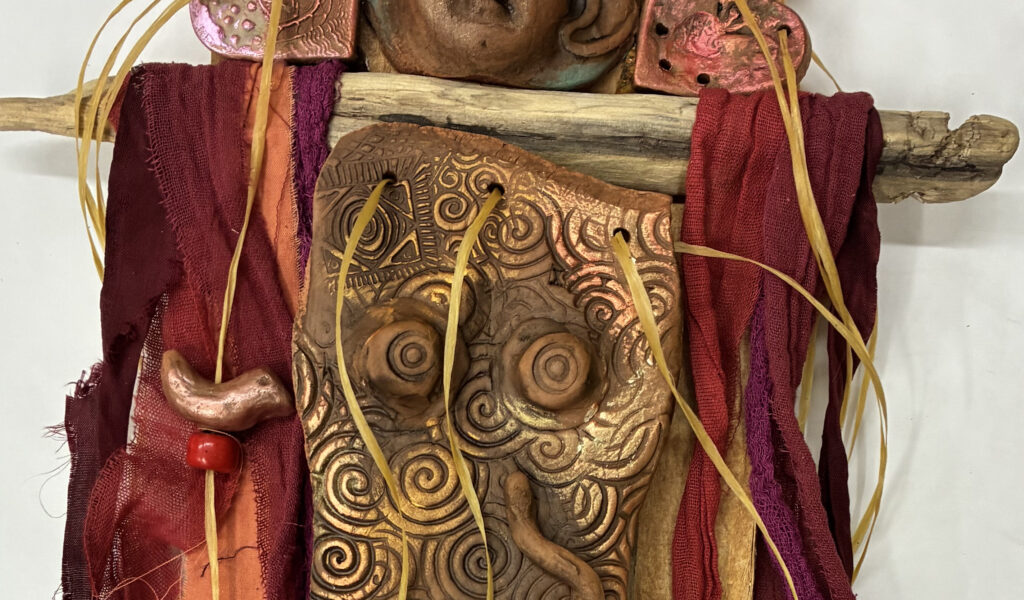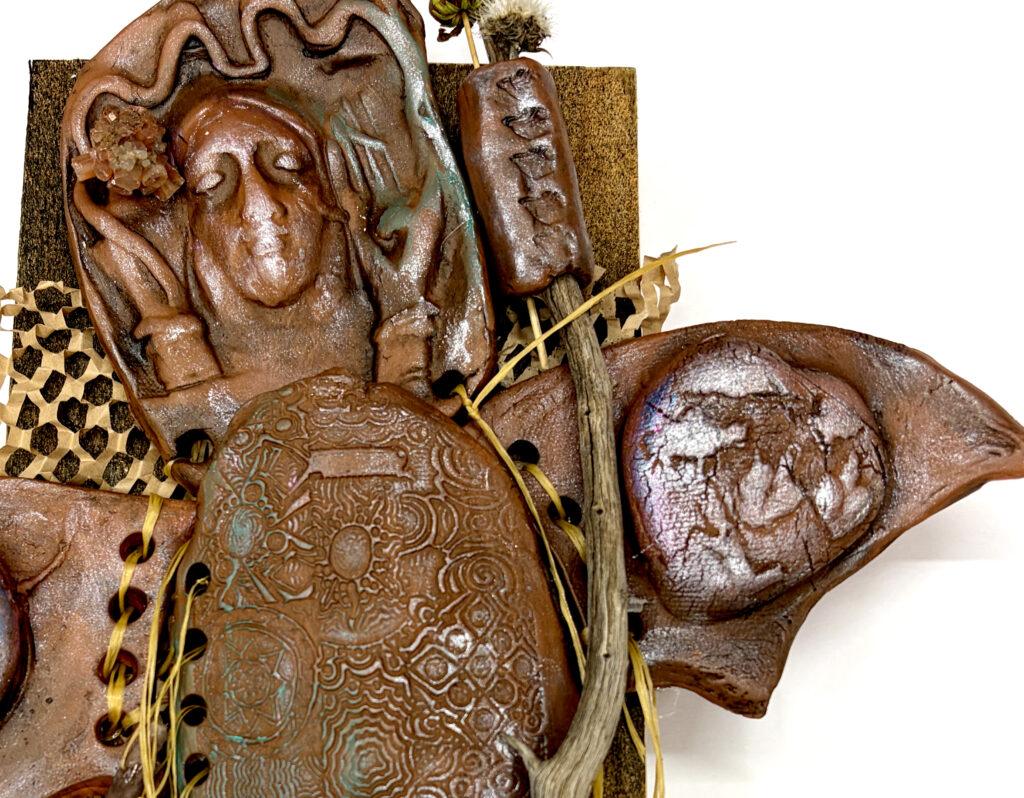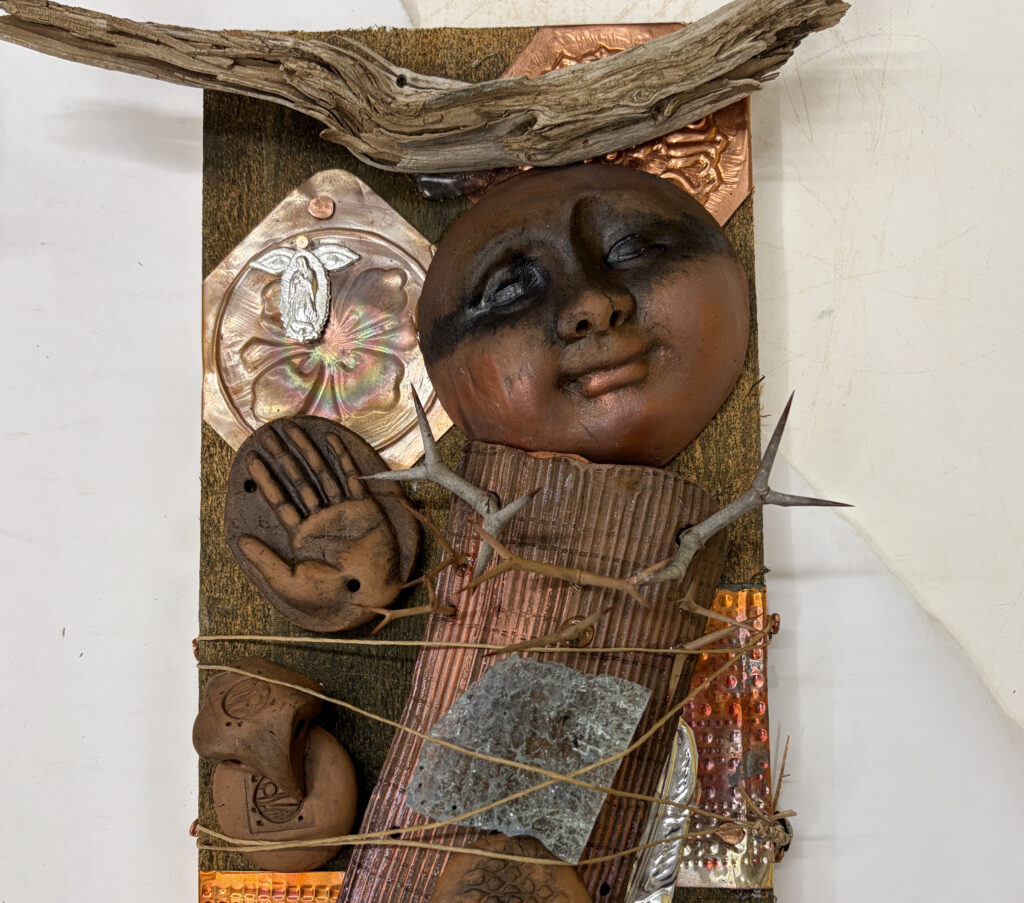
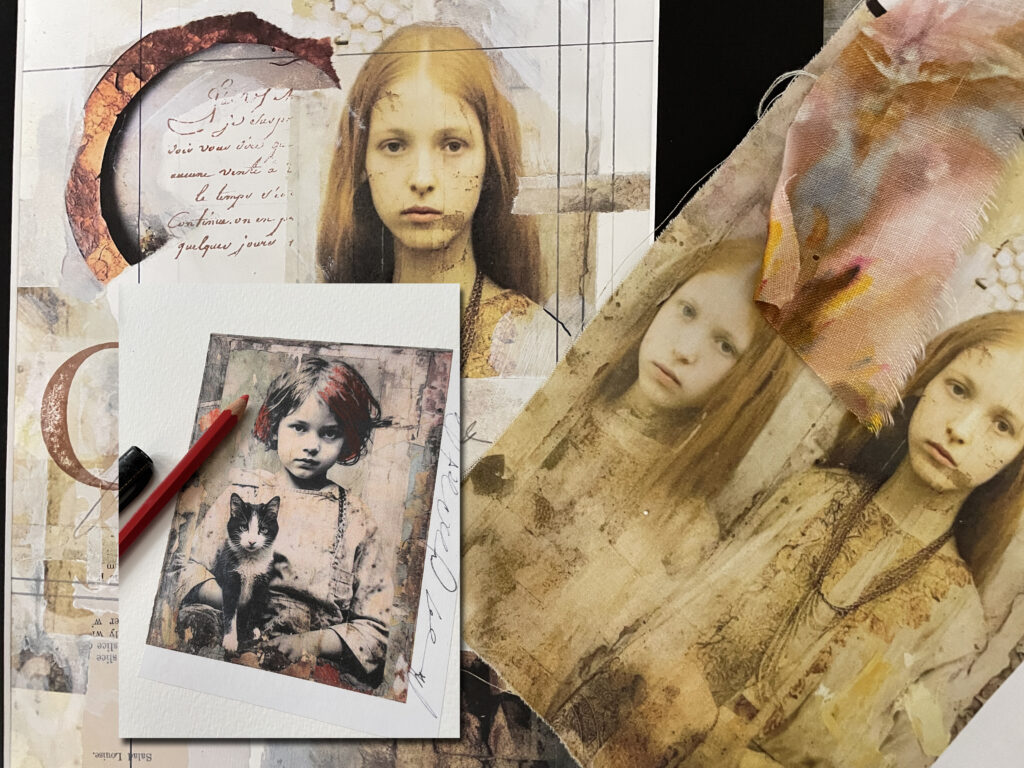
Fragments, Forms and Layers: Part Three

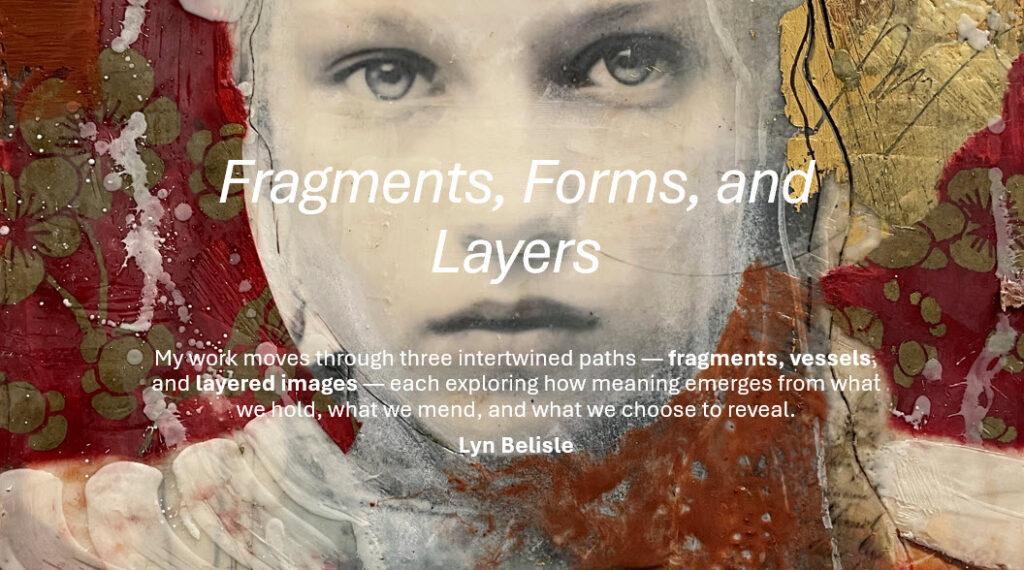
Part 3: Layered Images — The Original Language in My Practice

A three-part series on Fragments, Vessels & Layers
(Part Three: Layered Images)

Series Introduction

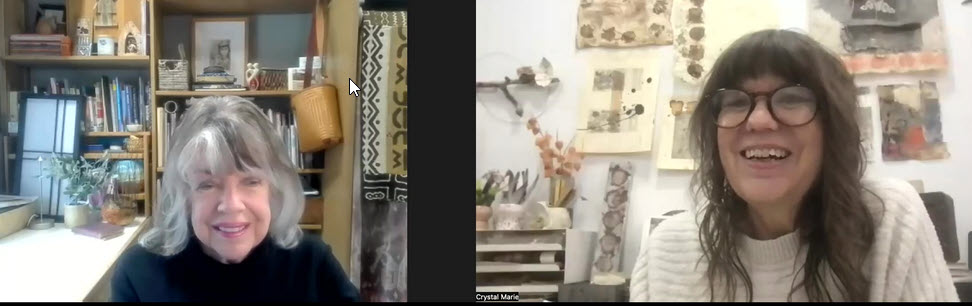
Recently, the artist and teacher Crystal Marie Neubauer invited me to talk with her online group about my work. It was an honor — Crystal’s influence on my creative life goes back years — but it also presented a surprising challenge. How do you describe an art practice that moves through so many materials and forms? Encaustic, collage, fiber, clay, found objects… I’ve never been a one-medium artist, and trying to explain everything at once felt impossible.

Then I realized that my work isn’t united by medium at all. It’s united by object and intention — by the three forms that keep reappearing no matter what I’m making.
And when I stepped back, those paths became clear:

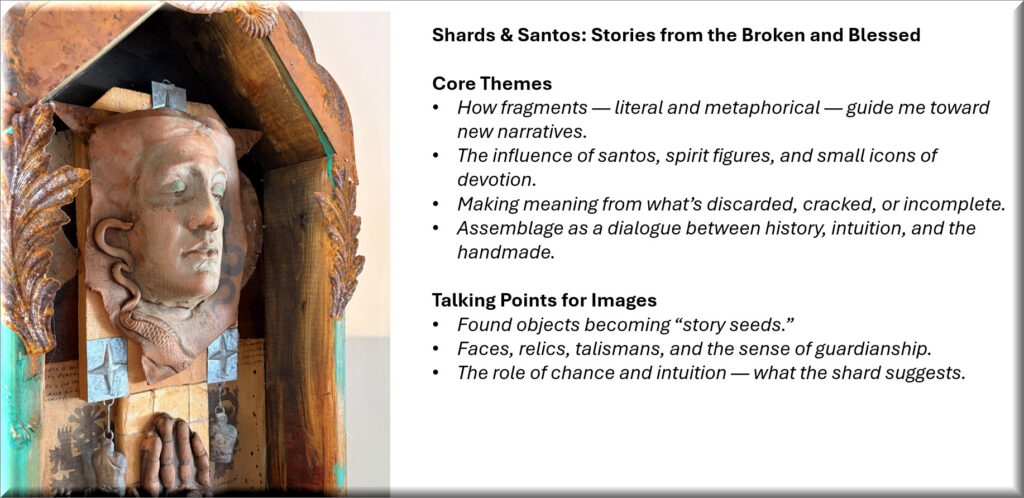
  • Santos & Shards — guardians, icons, and the stories held in fragments

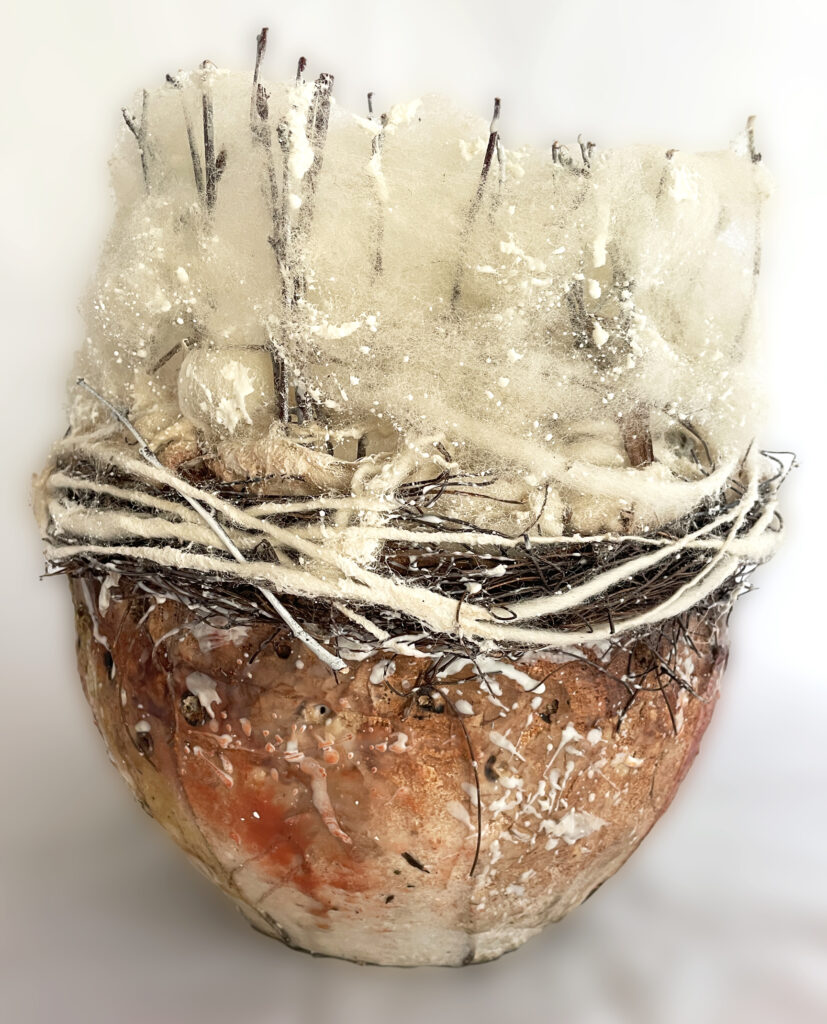
  • Vessels — boats, bowls, pods, and the metaphor of holding

  • Layered Images — collage, wax, and the  revelations inside translucence

These three paths intertwine across everything I do. And this series grows out of that realization — an invitation to look closely at where my work comes from and how meaning travels across forms.

Today’s final post in this series returns to the oldest language in my practice: layered collage.

Layered Images — The Core and Heart of My Work

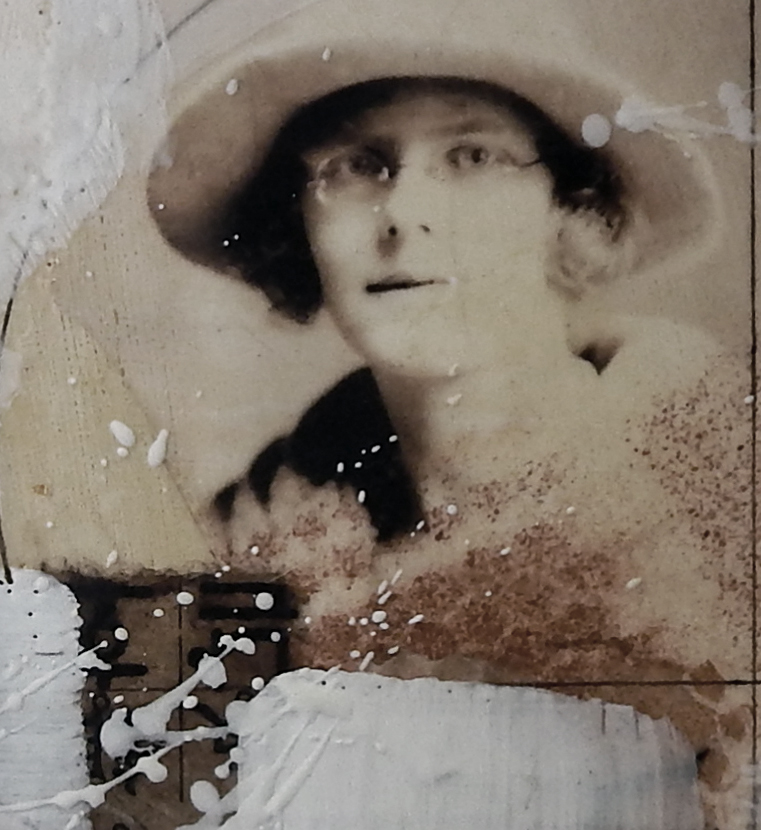
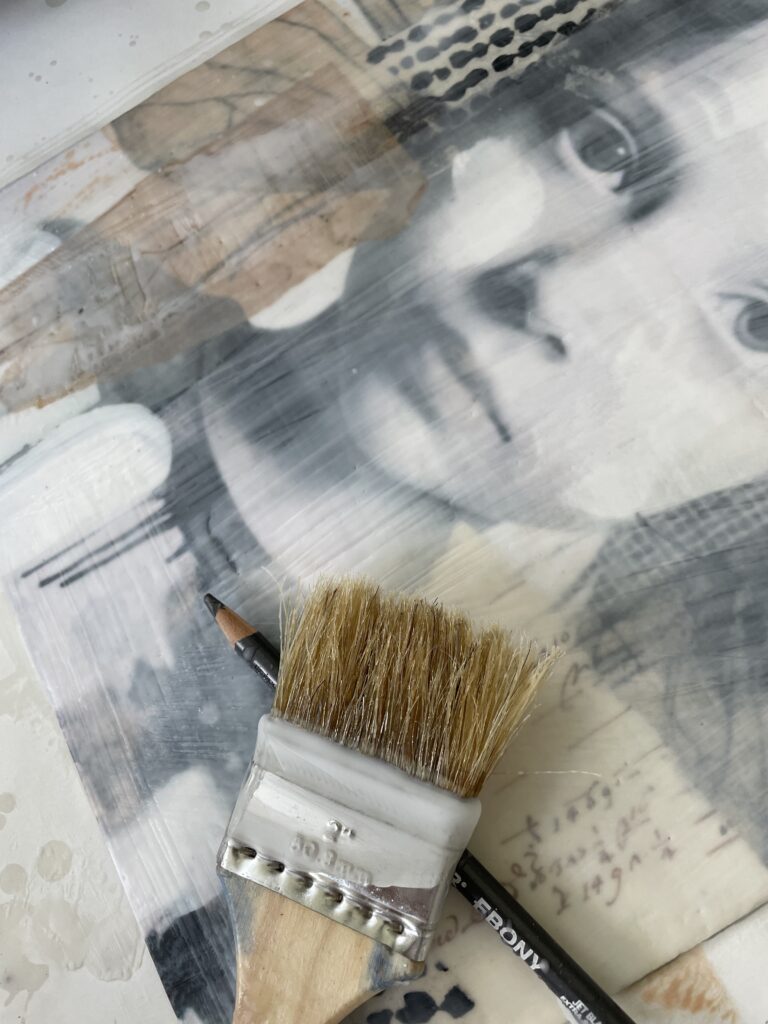
Before my Santos emerged, before I began building boats and pods and sheltering forms, I was working in layers — paper, pigment, image, and – more recently – wax. Collage was my first real artistic home on the flat surface, and it remains the place I return to whenever I need to rediscover what I’m trying to say.

If Shards & Santos are about what we mend, and Vessels are about what we hold, then Layered Images are about what we choose to reveal — and what we allow to remain veiled. I’ve always worked in collage and for the last 15 year I’ve concentrated on encaustic layering thanks to my dear friend Michelle Belto who introduced me to the medium.

Why does Wax play so well with collage? Because It behaves Like Memory

Encaustic wax feels like the perfect collaborator because it mirrors the way memory works:

  • luminous in some places

  • fogged or obscured in others

  • layered with traces of earlier thoughts

  • holding what came before, even as new layers are added

Wax isn’t just a sealant or surface — it’s a way of thinking. It slows everything down. It requires heat, patience, and attention. It asks: Are you sure you want this visible? Are you sure you want that hidden?

I don’t use much colored wax at all – I’m not an “encaustic painter,” rather an artist who uses encaustic techniques to tell mixed-media stories. The pale translucency of beeswax is my go-to collage medium of choice.
A Layered Image Is a Conversation

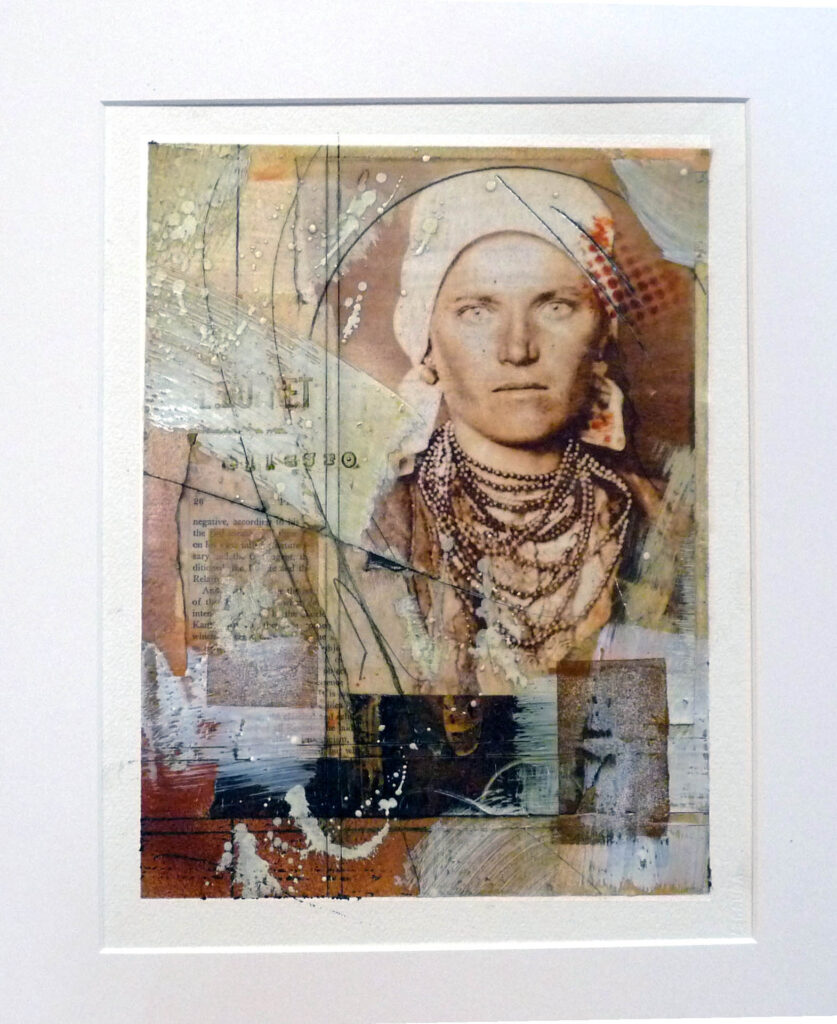
When I work in collage and wax, I’m not composing an image; I’m listening to it. Layer by layer, the piece begins to speak –a scrap of ledger paper peeks through, a synthographic figure emerges or dissolves, an accidental texture becomes the thing the piece needed all along. Even removal becomes part of the conversation. Scraping back a surface to reveal earlier marks often leads me to meanings I didn’t anticipate. Encaustic is not a linear process. It loops. It reveals. It forgets and remembers.
Just like we do.
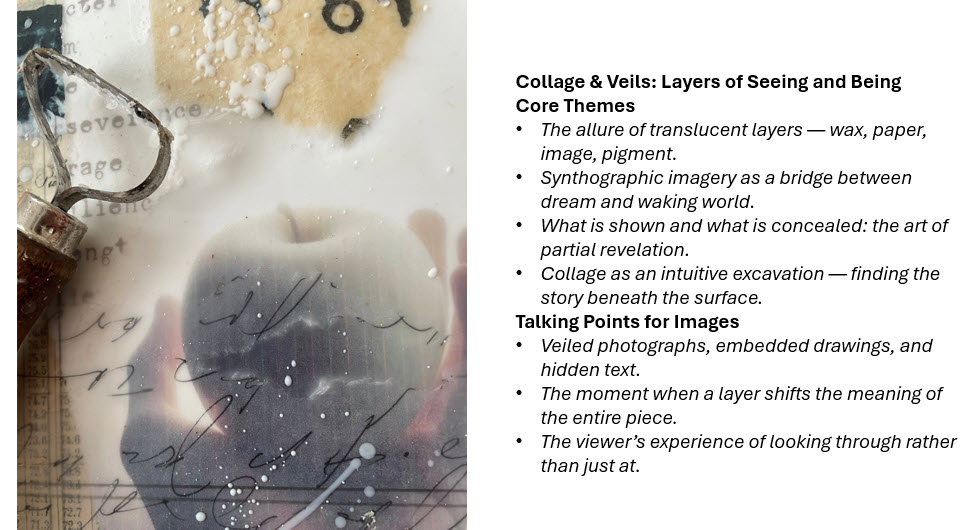
A Return to Old / A Portal to New

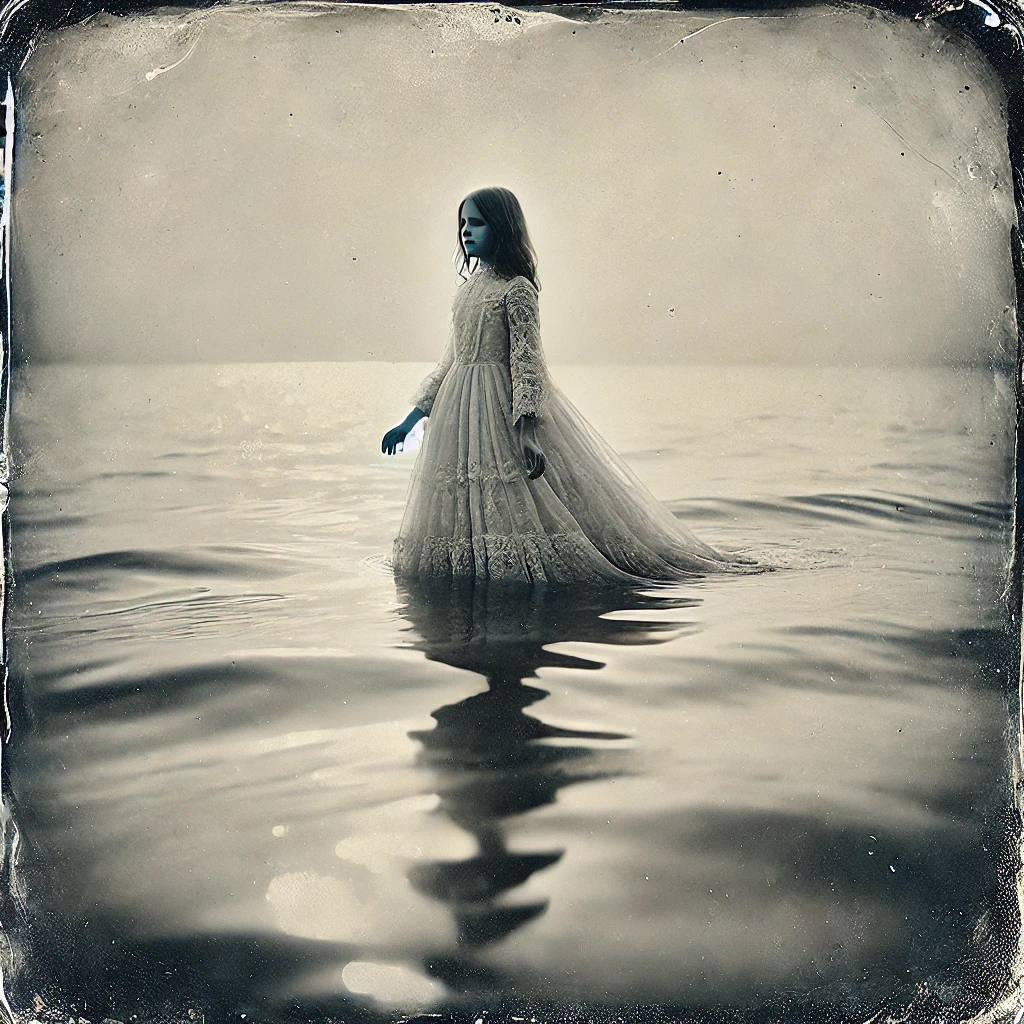
What I love most is that this old, familiar collage path has become a bridge to my newest work with synthographic imagery. The dream-logic of AI images blends beautifully with the ancient, tactile behavior of wax. One creates possibility; the other brings it to earth. If you’ve taken my recent Painting with Fire Lesson, Synthography and Wax, you understand.

The two together create a layered world where fantasy becomes grounded, realism becomes dreamlike, and the viewer is invited inside the luminous in-between

It feels like a collaboration across centuries — digital imagination meeting an art form older than painting itself. These aren’t just surfaces — they are strata.
Inviting You Into the Layers

Even if you don’t work in collage or encaustic, layering is a language almost every artist speaks. It’s about building meaning slowly, letting some things rest beneath the surface, allowing others to shine through.

Layers give us permission to be complex. To hold contradictions. To let time become part of the piece. As an example, here is a new (almost done but not yet – the edges are still taped) series that goes with my Encanto assemblages and will be in the Taos Exhibit in 2026.

I’m creating four layered encaustic collages, 20″x20″, each representing a child saint or Santo Niño. Technically, some are probably female Santas, but gender is not an issue here. Fusion is, fusion of layers and culture.

These Santo Niños inhabit the liminal space where Indigenous cosmologies and European Catholic iconography meet, overlap, and transform one another. The white-painted faces echo ritual marking found across Native traditions, signaling spiritual passage, ancestral presence, and worlds in transition. Their frames and gold-leaf halos recall Spanish devotional art, yet the children themselves do not belong fully to that lineage.

They are hybrid beings—part saint, part spirit-guardian—born of a cultural collision that reshaped the sacred landscape of the Southwest. 

I’ve layered mulberry paper printed with carpet designs and birds than might be found in a European drawing room with white painted synthographic faces of anonymous children to create contradictions and layers of metaphor and storytelling. Here they are so far – they may end up with one more layer of meaning but I’m just not sure:
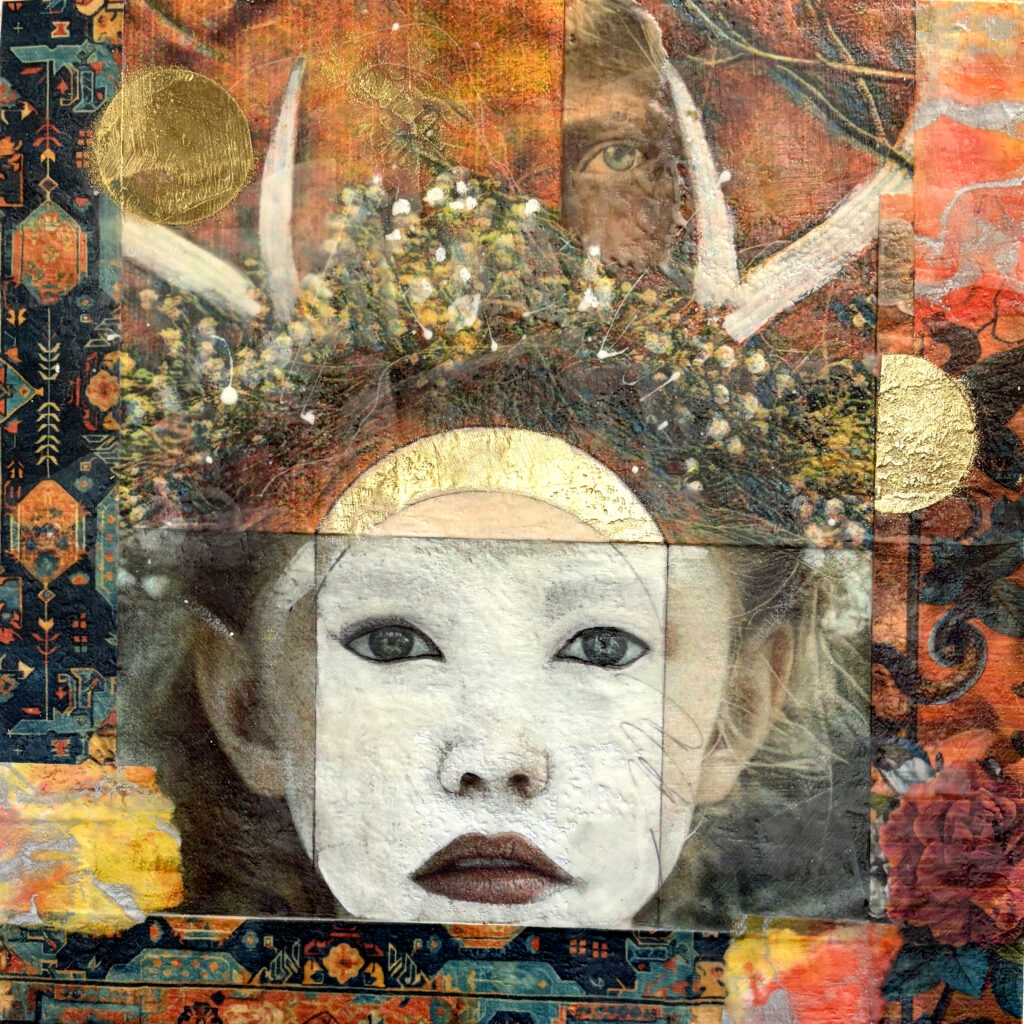
Santo Niño of the Antlers and the Hidden Path
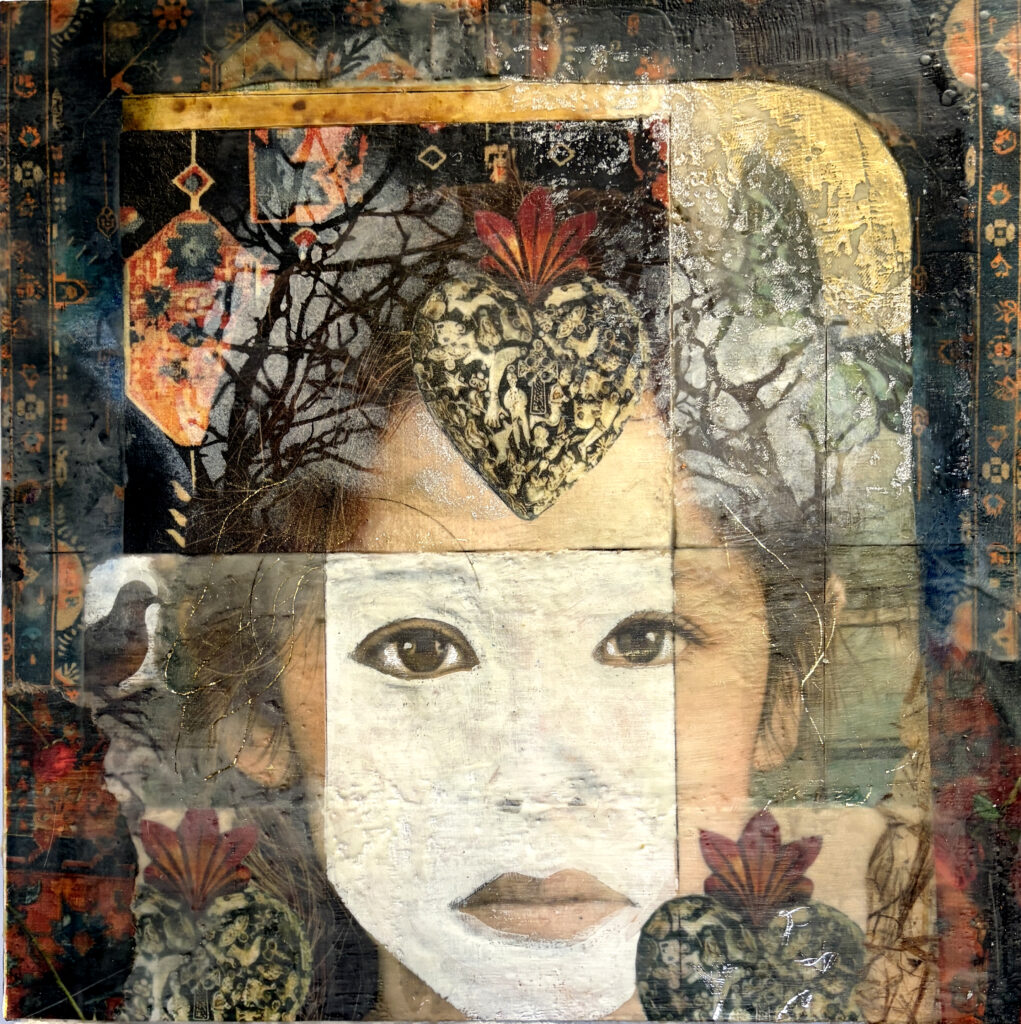
Santo Niño of the Sacred Heart Seed
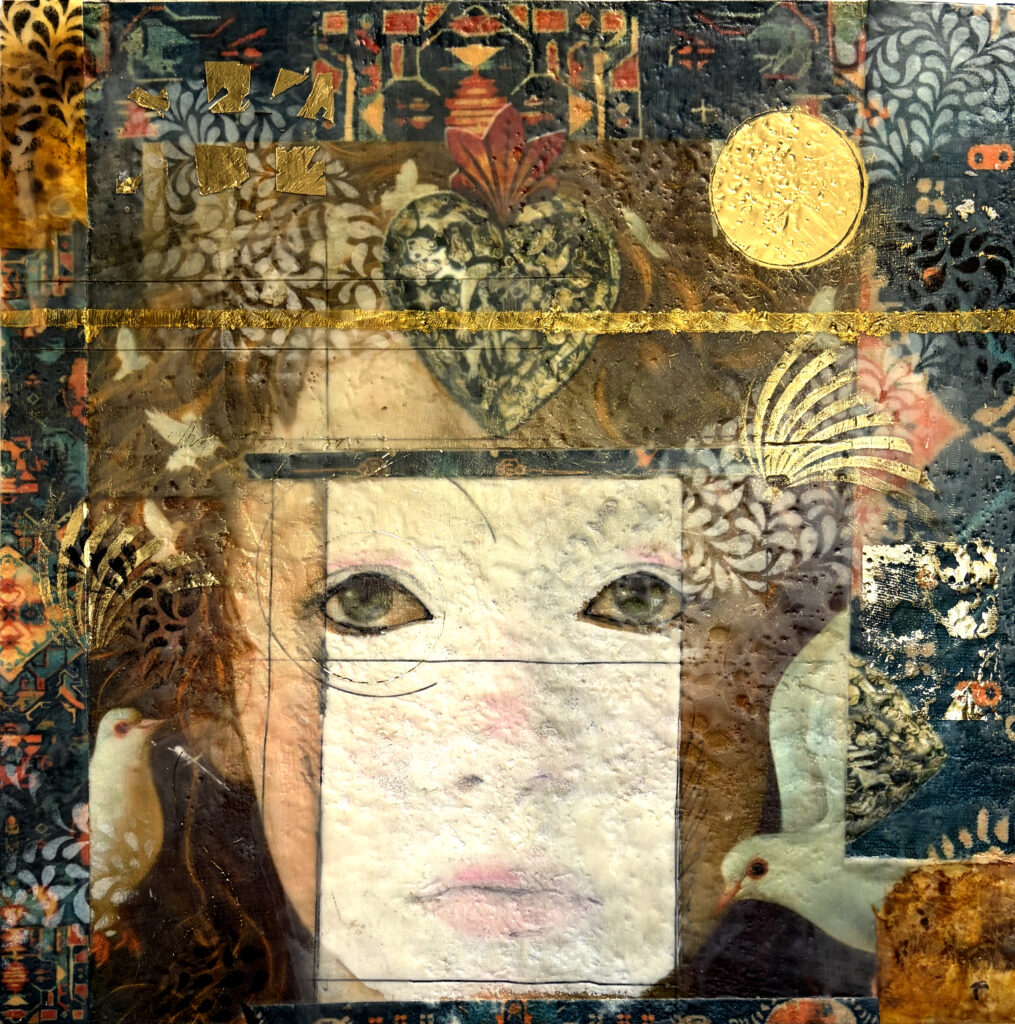
Santo Niño of the Two Doves
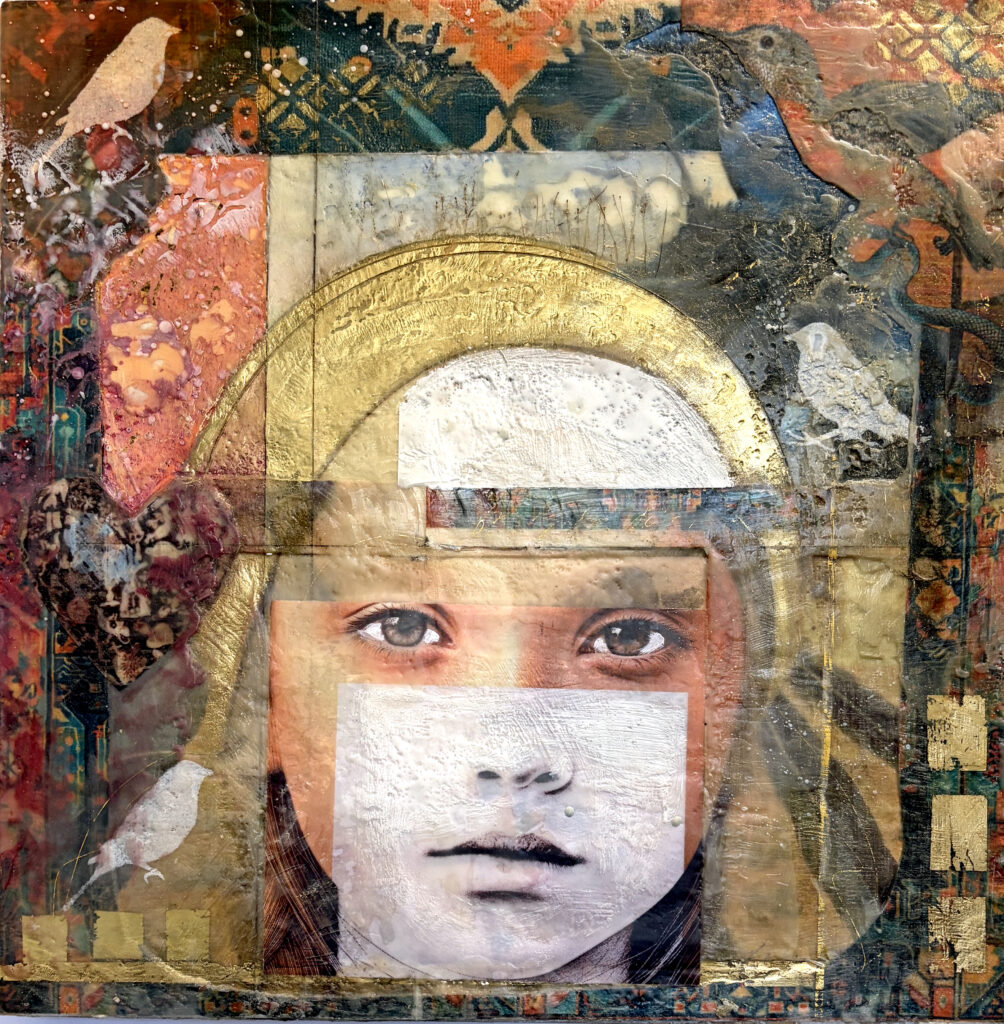
Santo Niño of the Watching Birds

There is more color in these layered pieces (surprise!), but the printed color is pushed back by the veiling layers of wax, almost as if time-faded. I’m having an amazing time fitting the images to the layers of history and meaning in the whole concept of Encantos and objects of hope and devotion in a world where such things need to be extracted again from our deep sense of humanity.

Whew! That was  lot to talk about!

Here are a few prompts to bring into your own studio:

  • What early layer in your work deserves to resurface?

  • What do you want to soften — not erase — with a new layer?

  • How might your materials become translucent instead of opaque?

  • Is there an image in your practice that wants to hide and reveal itself at the same time?

Closing the Trilogy

With this third post — fragments, vessels, layers — the series comes full circle. Each path has shaped my work in different ways, but together they form a single through-line:

We create meaning from what we mend, what we hold, and what we choose to reveal.

Thank you for walking with me through all three.
Fragments, Forms & Layers: Part Two

Last week, the remarkable artist and teacher Crystal Marie Neubauer invited me to speak with her online community about my work — an honor, and also an unexpected challenge. How do you describe an art practice that moves fluidly through so many materials? Encaustic, collage, clay, fiber, found objects… it’s never been about one medium.

What I realized is that my work is held together not by technique but by form and intention. Three recurring paths kept surfacing:

Santos & Shards — guardians, icons, and the stories held in fragments
Vessels — boats, bowls, pods, and the metaphor of holding
Layered Images — collage, wax, and the quiet revelations inside transparency

These forms thread through everything I make and shape how I think about narrative, memory, devotion, and protection. This three-part series grew from that conversation with Crystal’s group — an invitation to look more closely at how these paths emerge and how others might recognize echoes of their own practice along the way.

Part 2: Vessels of Holding — Forms That Carry Memory

A three-part series on Fragments, Vessels & Layers

In PART ONE, we talked about shards and stories and fragments.

If fragments are the invitations, vessels are the responses — the forms we create when we need to hold something gently, carry something forward, or protect something fragile. In my work, vessels have always been metaphors for care: what we shelter, what we offer, what we carry alone, and what we carry together.

This part of the series turns to the second creative path in my practice, one shaped deeply by my time teaching Spirit Vessels & Boats in Ireland. That workshop showed me how universally we understand the language of vessels — not just as objects, but as personal metaphors.

NOTE: If you read to the bottom of the post, there is some information about a new in-person Vessels workshop coming up in February.

Vessels as Small Architectures for Memory

A vessel is more than a container. It’s a small architecture — a structure built from tenderness and intention.

In my own studio, I return again and again to:

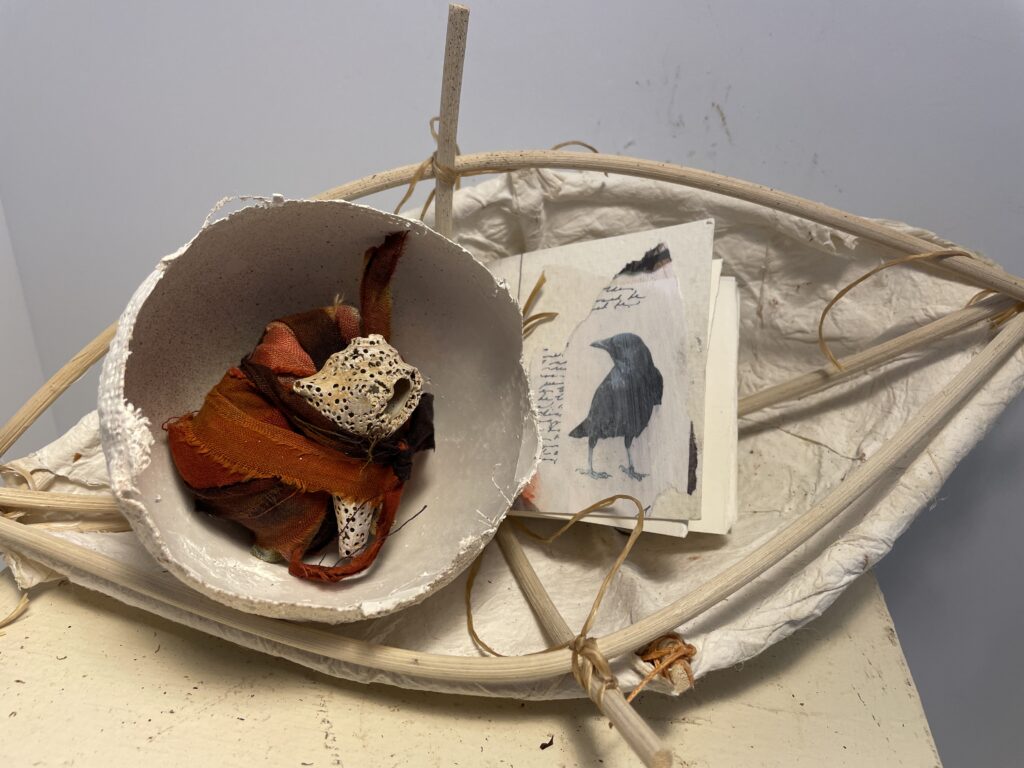
  • cane lashed into curved frames,

  • mulberry paper toughened with wax,

  • bits of rusted metal becoming anchors,

  • fiber and thread creating protection or boundary.

Each material changes the meaning of what the vessel carries. Wax, especially, offers a luminous kind of shelter — the sense that something is being preserved inside layers of translucence.

Teaching in Ireland: A Workshop of Passage and Light

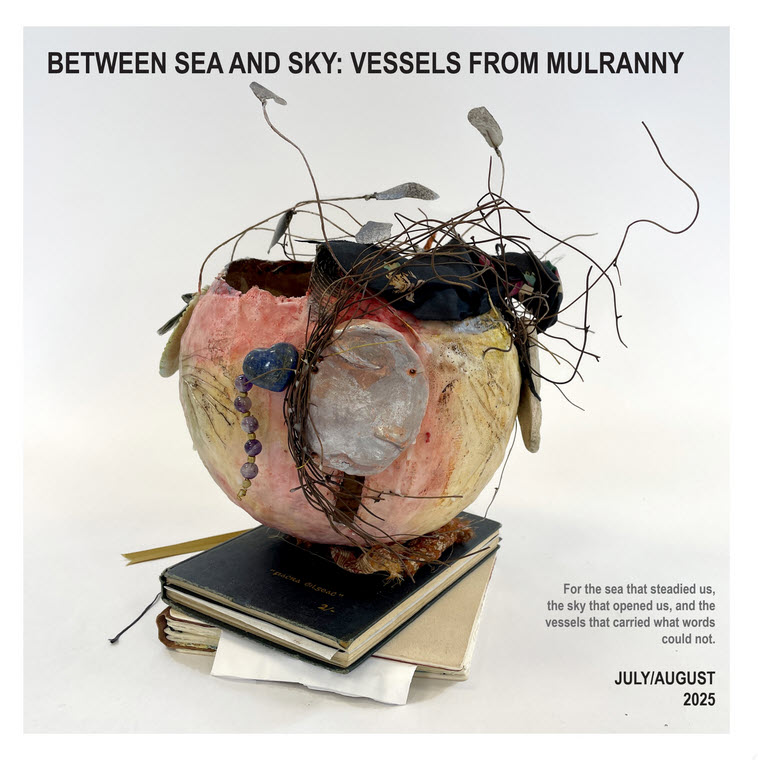
When I taught this work in Mulranny, surrounded by sea light, tidal flats, and the slow breathing of the bay, my students immediately understood that they were making more than objects. They were making carriers — of memory, metaphor, hope, grief, gratitude.

Their vessels took on astonishing variety:

  • Some resembled wind-bent boats, as if carrying stories across an invisible tide.

  • Some were seed-like pods holding untold wishes.

  • Some were protective containers woven from cane, stitched paper, and beeswax, glowing like small lanterns.

There was a shared sense that these forms — however small — were honoring something beyond themselves.

Interior Space / Exterior Form

One of the most compelling conversations in the workshop was about the relationship between:

  • the space inside the vessel,

  • the form surrounding it,

  • and the meaning created by the tension between the two.

In a vessel, the interior always matters. It holds the intention. The exterior only reveals part of the story — the rest is protected within. This interplay mirrors how we move through the world: showing some things, guarding others, and trusting the container to hold what words cannot.

_________________________________________

Speaking of words, I am teaching a new two-day in-person Vessel workshop next year on Valentines Day weekend at UTSA/SW. It’s called Vessel Alchemy: Tactile
Poems in Fiber , Paper , Word, Light. Here’s a partial description from the catalog:

“In this immersive workshop, we’ll explore how simple
materials (sticks, cheesecloth, mulberry paper, fiber scraps,
ink) can be transformed into vessels that speak to memory,
meaning, and the ephemeral. Each day invites an unfolding
of form and story as we sculpt, wrap, write, embed, and
embellish.”

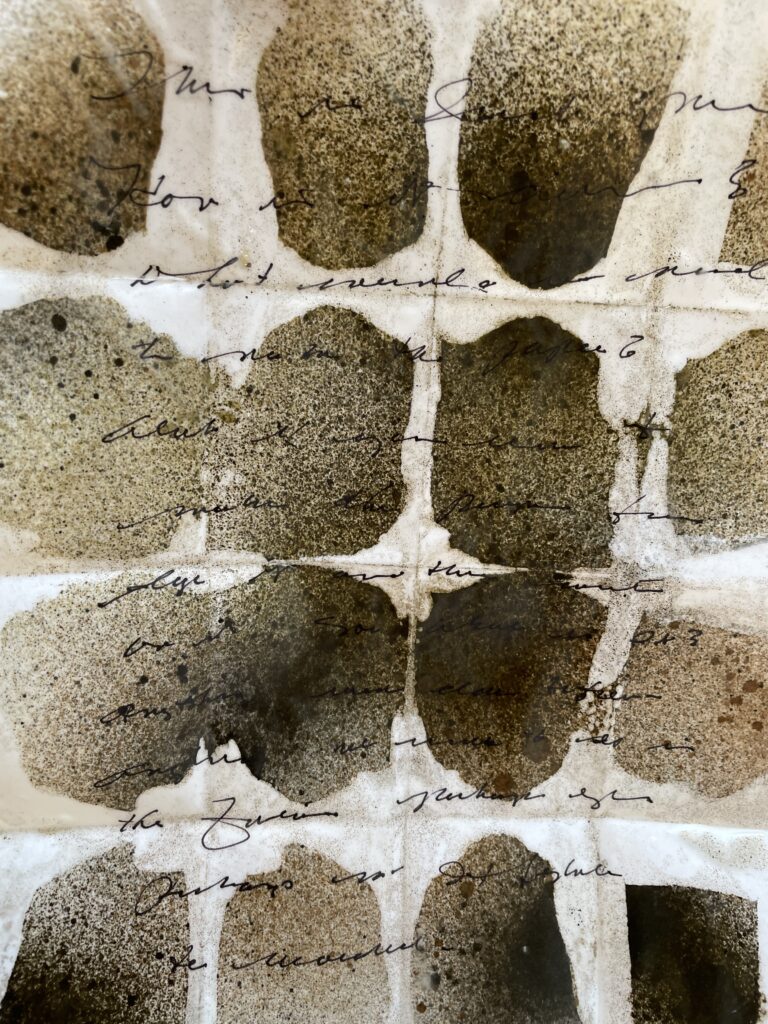
We’ll be doing some writing – words and poems and asemic mark making – here is a beautiful example from my friend Jean Dahlgren, who will be my TA for this class.

I love Jean’s asemic writing – she’s promised to write some lines on tissue paper for us to use in the workshop!

Workshop Registration for Friends of the School opens today, and it opens to the public on December 9th. I’d love to see you there!

If you can’t make it to the in-person workshop in February, you are welcome to checkout my online workshop called Spirit & Form: Creating Vessels of Passage and Purpose.

Here is a link to a sample lesson and the registration information. It’s self-paced and only $59 for lifetime access.

Inviting You Into the Studio: What Are You Carrying?

Even if you’ve never lashed cane or dipped mulberry paper into wax, you’ve likely made vessels in your own way — forms that hold meaning.

So here are some studio invitations for your own practice:

  • Could a boat, bowl, pod, or wrapped bundle be a metaphor waiting to be explored?
  • What would a “protective container” look like in your materials?

  • What happens when you build a structure around an emotion, a memory, or a small sacred object?

  • What materials in your studio feel inherently protective — wax, fiber, metal, clay?

A vessel doesn’t need to be functional to be truthful. It can simply be a place where meaning rests.

Looking Ahead

Next week, in Part Three, I’ll explore the last of the three intertwined paths: Layered Images — how veiled surfaces, hidden elements, and translucent strata reveal what is usually unseen.

Fragments, Forms & Layers, Part One

Series Introduction 

This week, the remarkable artist and teacher Crystal Marie Neubauer invited me to talk with her online group about my work. It was an honor — Crystal’s influence on my creative life goes back years — but it also presented a surprising challenge. How do you describe an art practice that moves through so many materials and forms? Encaustic, collage, fiber, clay, found objects… I’ve never been a one-medium artist, and trying to explain everything at once felt impossible.

Then I realized that my work isn’t united by medium at all. It’s united by object and intention — by the forms that keep reappearing no matter what materials I’m using. And when I stepped back, three clear paths emerged:

  • Santos & Shards — guardians, icons, and the stories held in fragments

  • Vessels — boats, bowls, pods, and the metaphor of holding

  • Layered Images — collage, wax, and the quiet revelations inside transparency

These three paths intertwine across everything I make. They shape how I think about narrative, memory, devotion, protection, and the unseen layers beneath the surface.

This three-part blog series grows out of that conversation with Crystal and her community — an invitation to look more closely at where my work comes from, how it evolves, and how other artists might find echoes of their own practice in these structures.

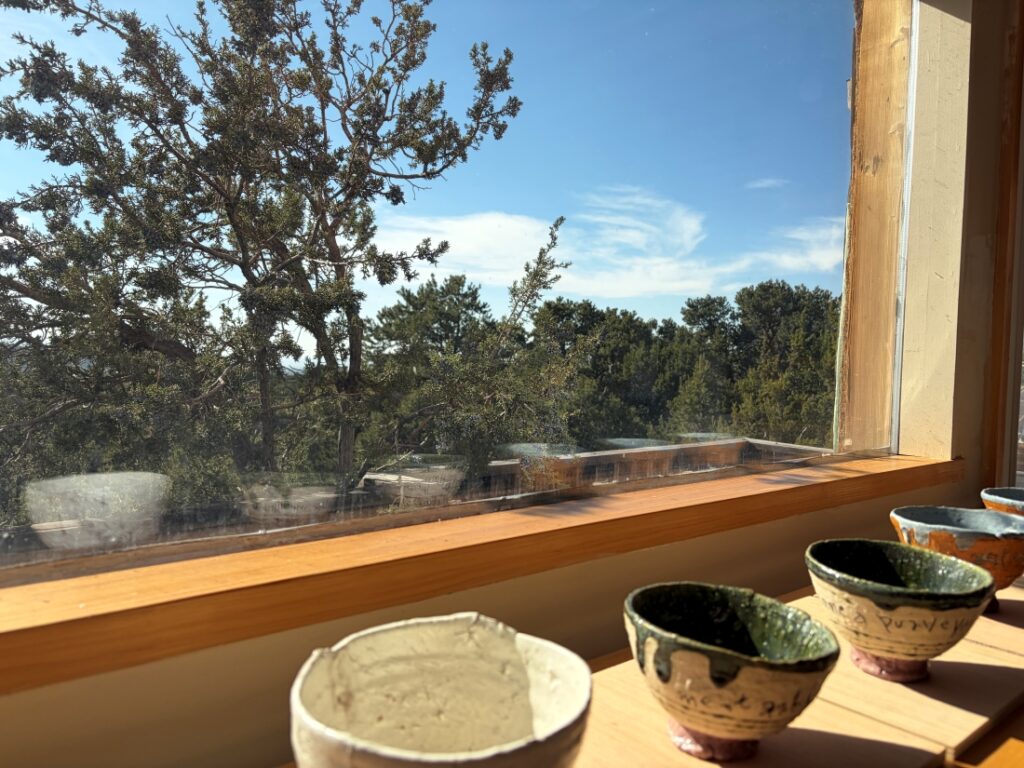
Taos Ceramic Center Workshop – Shards and Santos

Part 1: Shards & Santos — Stories from the Broken and Blessed

A three-part series on Fragments, Vessels & Layers

We rarely begin with a whole story. More often, meaning appears in pieces — a scrap of paper, a chipped relic, a bit of fabric softened by time. Over the years, I’ve learned that these fragments are not the leftovers; they’re the invitations.

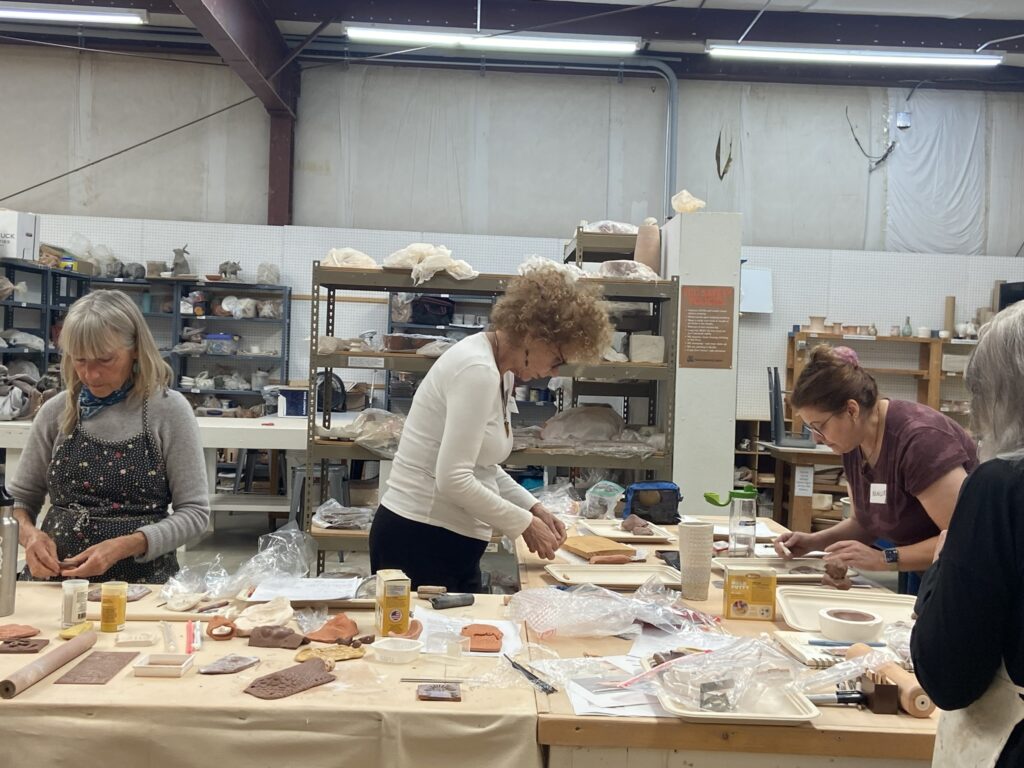
This first post in my three-part series returns to the roots of an idea that has shaped much of my work — and shaped the work of many artists I’ve taught, especially during my Shards & Santos workshop in Taos. That circle of students helped me see just how universal the language of fragments can be.

How Shards Become Stories

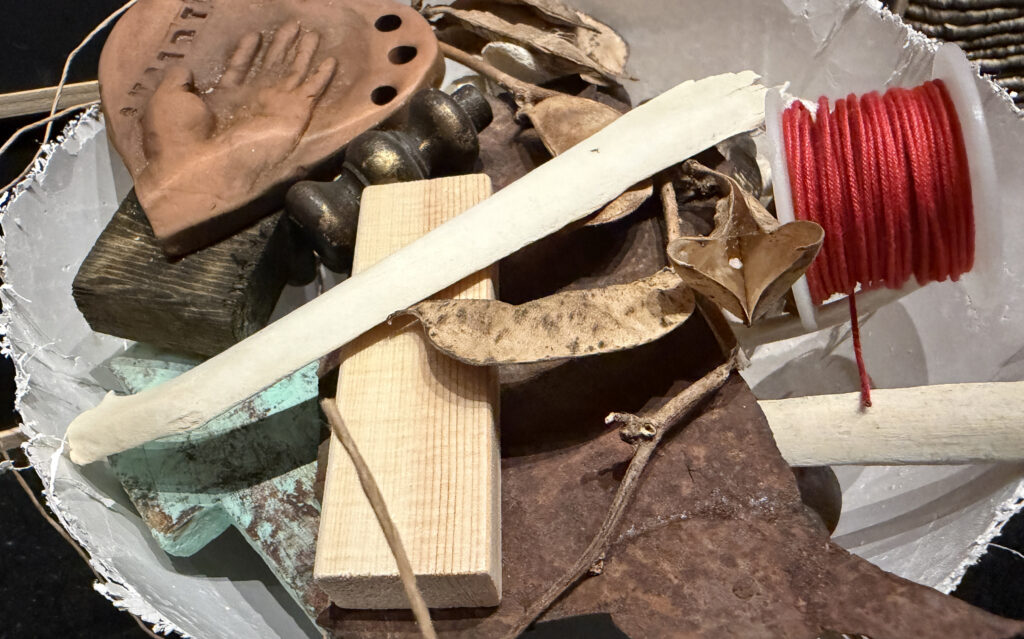
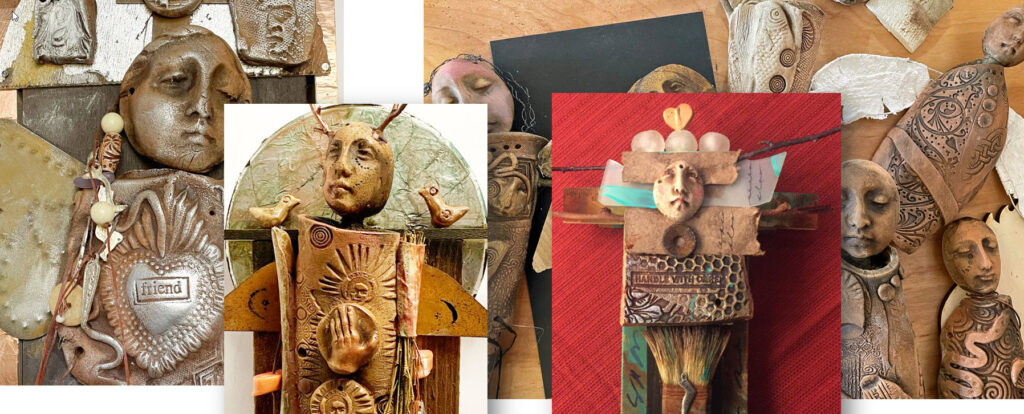
In my own practice, fragments arrive like clues: a small clay face, a scrap of rusted tin, a wooden bit that once held something together. But in Taos, I watched my students discover that same moment of recognition — the instant a found object becomes a story seed.

One student picked up a cracked porcelain doll arm and immediately said, “She’s reaching for something… I don’t know what yet.” Another wound red thread around a bundle of broken twigs, transforming it into a line of healing. Someone else combined milagros and fabric scraps into a small guardian who looked both ancient and brand new.

Their work reminded me that the power of fragments isn’t personal to me — it’s common to all of us who rely on intuition, accident, and memory to guide the creative process.

Santos, Spirit Figures & the Art of Devotion

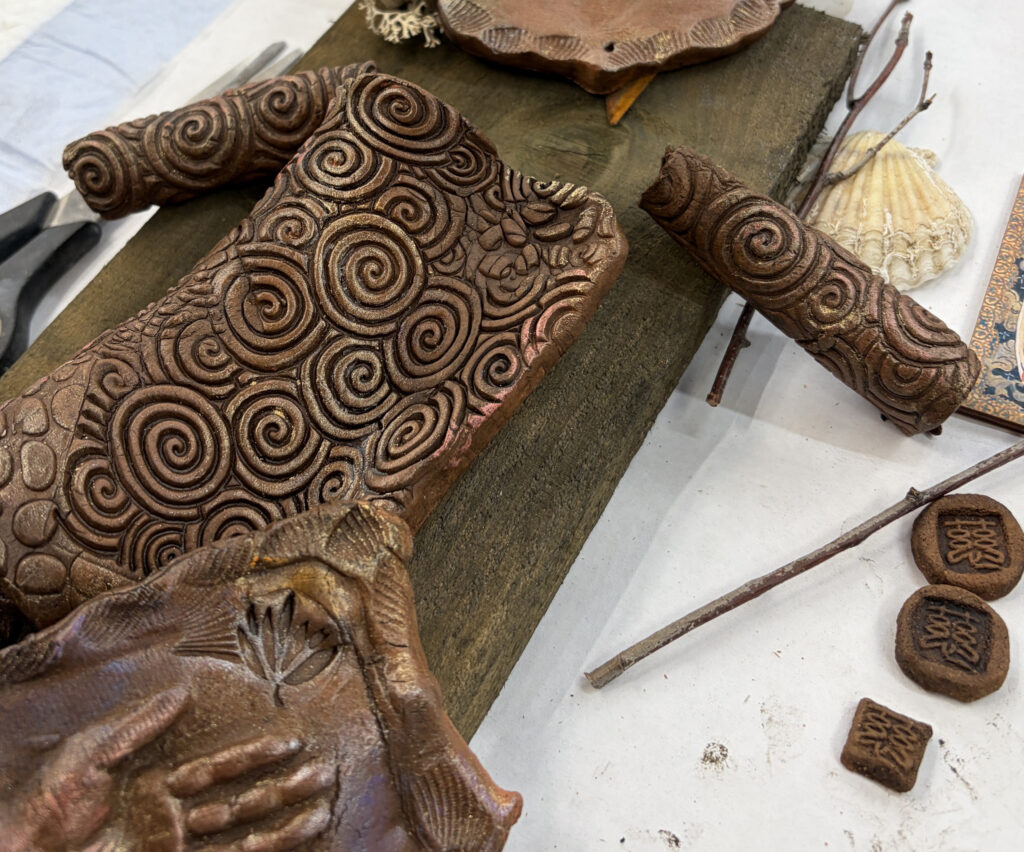
My own santos and spirit figures grew from this love of broken, found, and humble materials. They echo the devotional folk traditions of the Southwest and northern New Mexico, where handmade imperfection is embraced as a sign of humanity.

In Taos, my students instinctively reached for the same archetypes — watchers, keepers, protectors. Their figures weren’t copies of mine; they were something deeper: their own histories embodied in small forms. Some appeared fierce. Some gentle. Some humorous and unexpected. But each one performed an act of trust and devotion: taking what is overlooked and turning it into things that matters.

Teaching in Taos: A Circle of Making and Mending

The workshop gave me a front-row seat to the creative courage required to work with fragments. No one started with a clear plan. Everyone started with pieces.

And I saw how quickly the shards guided them:

  • An animal bone became the spine of a tiny santo.

  • A found seed pod became a symbol of protection.

  • A scrap of handwritten ledger paper held the echo of an unknown voice.

These transformations reminded me that assemblage is not just a technique — it’s a way of mending meaning.

Inviting You Into the Studio Conversation

Even if you weren’t in that room in Taos, these ideas belong to you too. Artists everywhere — no matter the medium — work with fragments. Sometimes they are literal (material scraps, failed starts, bits of old work). Sometimes they are emotional or intuitive (memories, glimpses, unfinished thoughts).

From the presentation to Crystal’s Group

So here are some invitations for your own practice:

  • What three fragments are asking for your attention right now? Do they go together or are they separate stories – a series, perhaps?

  • What part of something incomplete could become the beginning of something new?

  • How might you create your own guardian figure — a studio santo — from the materials around you?

The beauty of working with shards and fragments is that nothing has to be whole to be meaningful. The “broken” thing is already full of story. Your job — our job — is simply to listen and find its true companions.

Looking Ahead

Next week, in Part Two, I’ll share the second path in this creative trio: Vessels — how boats, bowls, pods, and containers have shaped my work and helped me think about what we hold, carry, and protect.

Places That Remember Us

On Taos, Mulranny, and the Quiet Mystery of Recognizing Home


By Ernest L. Blumenschein –

There are places in the world that carry such a strong sense of identity that when we arrive, we don’t feel like visitors at all. We feel like returning.

Taos, New Mexico is like that for me. So is Mulranny, on the western edge of Ireland where the sea meets the boglands in a quiet, ancient conversation.

These places hold themselves with a kind of certainty. The land is layered with memory—geological, cultural, artistic, ancestral. You feel it in the air, the light, the way people move through their days. There is a coherence, a gatheredness, as though the place has been simmering itself down for centuries into something clear and undeniable.

When we step into such a place, something inside us recognizes that clarity. It’s as if a previously silent part of ourselves suddenly speaks up and says, Oh. Here. I know this.

This is different from nostalgia. Nostalgia is longing for something we remember. This is longing for something we have never remembered, but somehow always known.

Taos has that feeling. The Sangre de Cristo mountains rise behind the town like a presence, not a backdrop. They don’t frame Taos—they hold it. Even before I learned the stories of Taos Pueblo, the artists who came seeking mystery, and the long river of history flowing quietly there, I could feel it. There’s a strong connection to the San Antonio Art League here, too – many of the artists who are in the permeant collection of the Art League Museum were among those who began the Taos Society of Artists, founded in 1915.

Mulranny is similar, but in a softer, tidal way. There, the land whispers instead of declares. The beach stretches long and pale, seaweed and shells lining the tidemarks like messages. Every time I walk there, I feel I am being given something I once lost. Not returned in full—just enough to say, Keep looking. You are close.

Maybe this sensation comes from memory embedded in the psyche—our ancestors moving across continents, carrying landscapes in their bones. Or perhaps we simply recognize places that mirror the interior geographies we already carry.

Some of us have mountains inside us.
Some of us have coastlines.
Some of us have deserts.
Some of us have peat bogs and tide pools and drifting fog.

And when we find the physical counterpart to our inner landscape, it feels like home.

Last night, here in Taos, the idea revealed itself all over again. We stopped at a tiny wine bar tucked inside an old adobe building just off the plaza on Ledoux Street. The room was dim and candle-warmed, plaster walls worn smooth by decades of hands and weather. A traditional Irish band was playing—fiddle, guitar, bodhrán—music that rose and curled into the thick air like smoke. And there it was: Taos and Mulranny, braided together. The mountains outside, the sea in memory. Two places I love, both concentrated with history and spirit, appearing in the same breath of song.

We don’t need to live in these places to be shaped by them. Sometimes it is enough just to have stood there, breathed that air, walked that shoreline. They become part of our internal compass—a direction we can return to whenever we need to remember who we are.

We carry them with us.
Or perhaps—they carry us.

John O’Donohue
“Landscape is the firstborn of creation. It was here long before we ever arrived, and it will continue to be. When we walk on the earth, we are walking on the ancient body of our grandmother.”

I’ll be back home in San Antonio soon with Taos stories to tell, one that involves another “home” I found in Santa Fe that feels like it is in Japan.

How do you journey?

“If you don’t know where you are going, any road will get you there.” — Lewis Carroll

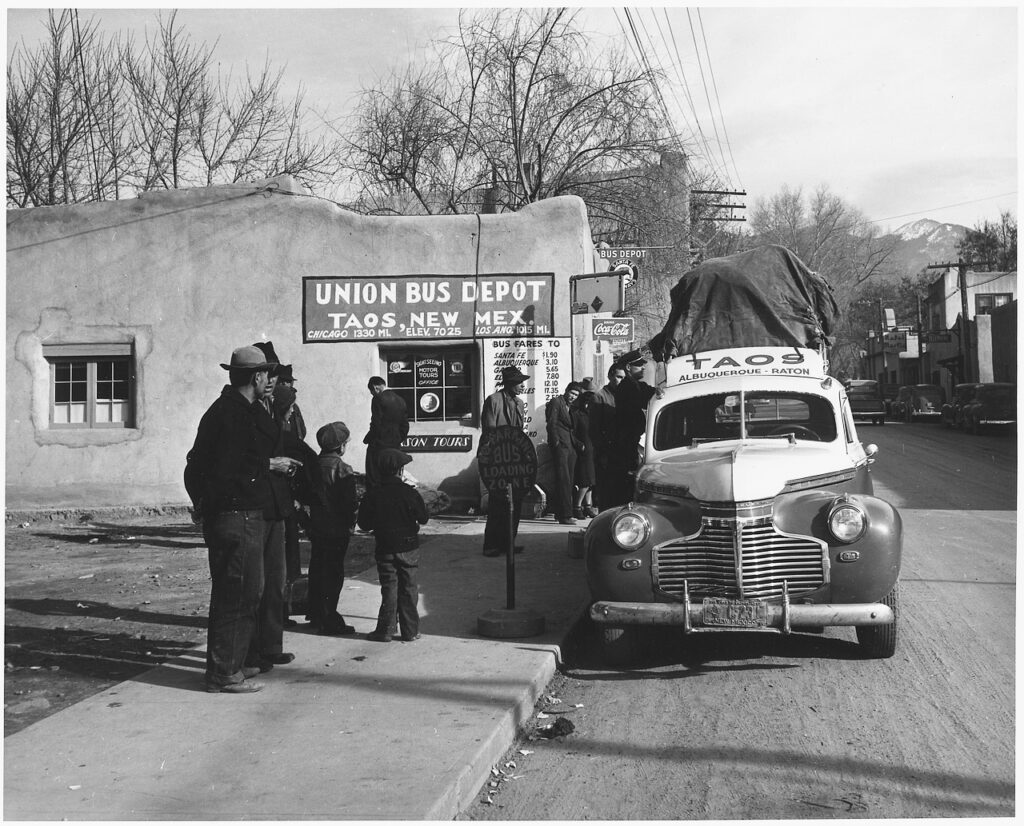
I’m getting ready to leave for Taos, New Mexico, to teach a class called Shards and Santos at the Taos Ceramics Center. We’re driving from San Antonio, and my husband (and beloved traveling companion) has already checked the road for both traffic construction and upcoming weather conditions. He knows where we will stop and how long it will take to get there.

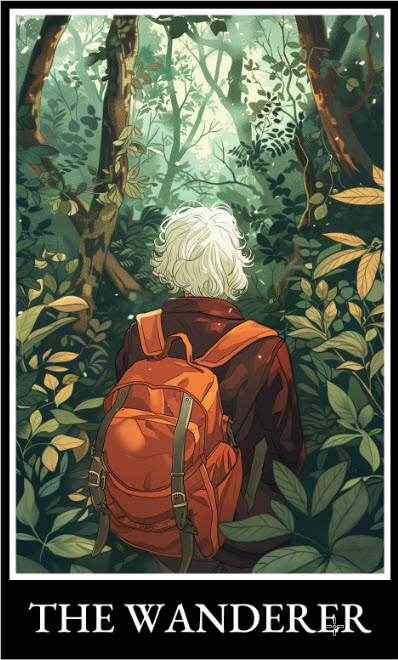
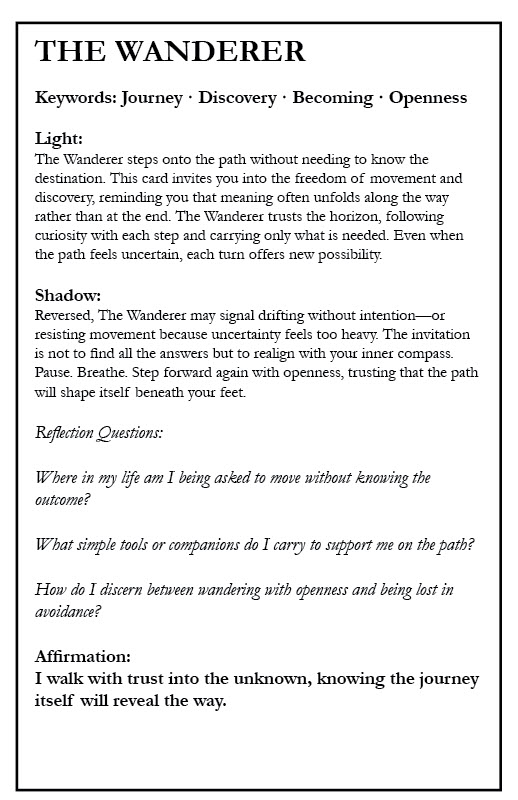
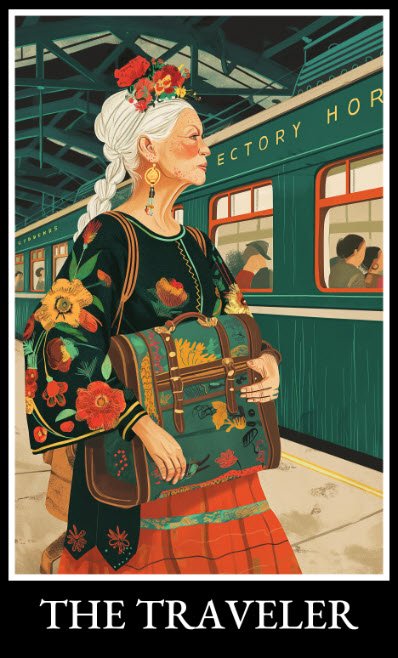
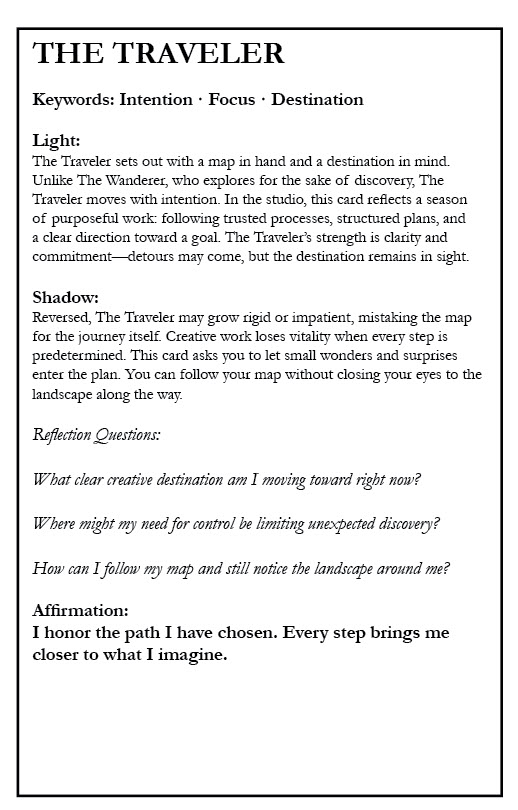
This is hugely reassuring! I’d probably just hop in and head northwest. And this topic a perfect lead-in to reflecting about how differently we chart our artist’s journey. I actually created two Oracle Cards to express this.

A section in the in-progress Enso Oracle book called Subtleties and Pairings: When Meanings Overlap says, “Some cards in The Enso Oracle may appear to speak the same language, yet their tones differ quietly, like two instruments playing in harmony. The Wanderer and The Traveler, for example, both move through the world, but their motives are distinct: The Traveler walks with purpose, guided by curiosity and direction, while The Wanderer drifts in openness, allowing intuition rather than intention to lead. One seeks, the other listens.”

Take a minute to think about this, and then see which card below fits your creative “journey style” the best.

Were you able to choose your “wayfinder archetype”?

As you were reading the two cards above, which one tugs at you today?– (it may change tomorrow)

If you’re The Traveler (purposeful path):

  • Name a destination for this week’s studio time in one sentence.

  • Pick one tool or constraint that will help you get there.

  • Five-minute map: sketch the sequence—Step 1 → Step 2 → Step 3.

If you’re The Wanderer (intuitive drift):

  • Begin without a plan: choose three materials by feel, not reason.

  • Follow the most interesting accident for 10 minutes—no fixing, only noticing.

  • Three lines in your notebook: What surprised you? What changed? What’s next?

Tell Me & Tell Each Other

In the comments, share which card chose you today that describes your approach, and
I’ll feature a few responses in the next post (with your permission).


I’ll be on the road to Taos soon—channeling a bit of Traveler (routes and rest stops – thank you, Beloved Traveling Companion) and a whole lot of Wanderer (open skies, new textures). Which one will guide you this week?

Hopefully, I’ll be able to post while I’m there – I’ll send pics!! Thanks for reading!

The Honeybee: A Late Addition

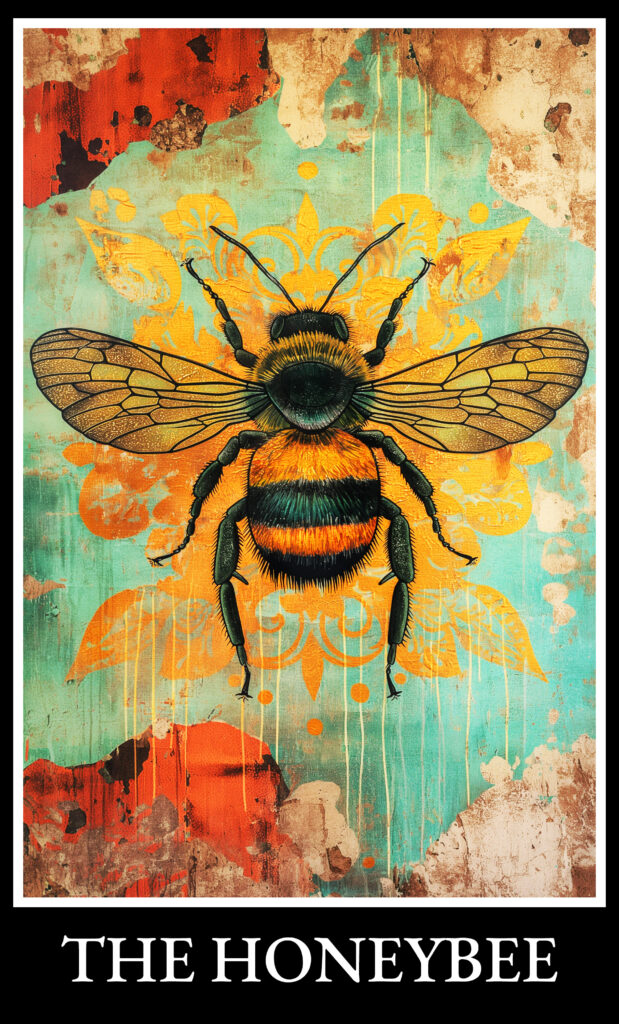
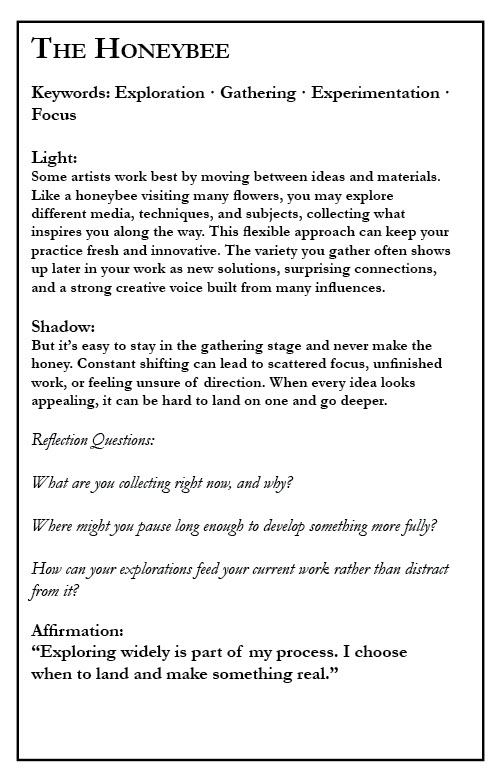
I was so close to calling the Enso Oracle finished. The paths were set, the 44 cards were balanced, and the framework felt solid. And then, almost out of nowhere, a single image and idea rose to the surface — The Honeybee.
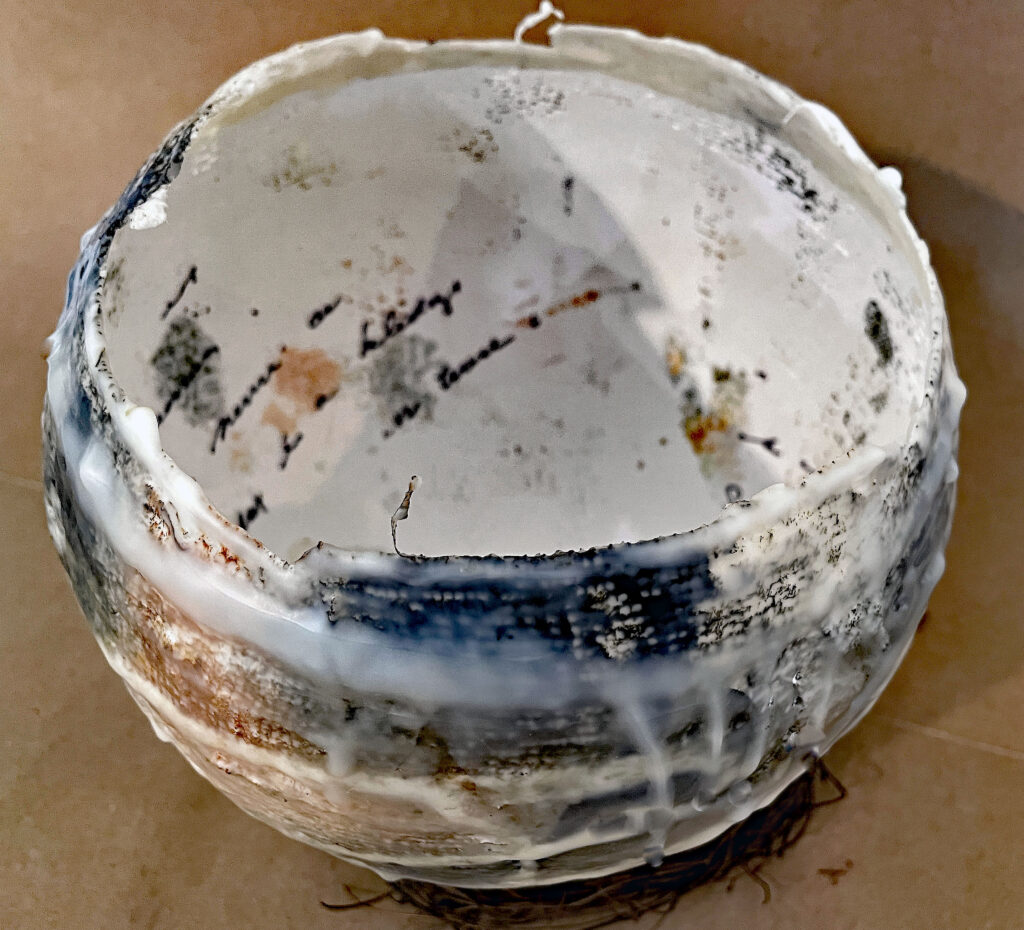
I kept thinking about the kind of artist who thrives on exploration. Someone who moves from one material to another, from idea to idea, gathering inspiration like pollen. Their work is enriched by variety — not scattered, but woven together from what they collect. Many of us know this way of working. Many of us are that artist.

The Honeybee acknowledges the beauty of that temperament: the flexibility, the curiosity, the openness to what’s new. But it also recognizes its challenge — the risk of never landing long enough to make something fully realized. In my own practice, I’ve seen both sides of this. I’ve been down many rabbit-holes and stayed down there too long. That’s why this card felt essential, even at the very end of the process.

Some of the things that I have learned and worked with, sometimes even taught, and wished I could stay with longer –

  • Eco-dyeing with plants
  • Saori weaving
  • Silkscreen / screen printing
  • Handmade artist books and zines
  • Monotype printing

I’ve kept little shards of technique from all of these but there just isn’t time to do justice to everything I want to do! Do you ever feel that way?

This card wasn’t part of the original plan. It arrived late, quietly, but with a kind of certainty. And sometimes, that’s how the truest symbols find their way in — not with a grand entrance, but with a simple nudge that says, don’t leave this out.

The Honeybee reminds us that exploring widely can be a strength, but at some point, we choose when to stay still long enough to make something real. For all the artists who gather widely before they go deep: The Honeybee is for you.

Which of these have you sampled?

  • Gouache
  • Oil painting
  • Ink drawing and brushwork
  • Botanical illustration
  • Needle felting
  • Natural dyeing
  • Surface design on fabric (e.g., block printing)
  • Knitting and crochet
  • Rug hooking or punch needle
  • Hand-built ceramics
  • Wheel throwing
  • Cyanotype and sun printing
  • Metal clay or simple metalsmithing
  • Resin casting
  • Found object jewelry
  • Fiber + bead hybrid pieces
  • Calligraphy and brush lettering
  • Papermaking
  • Origami or paper sculpture
  • Polymer clay sculpting
  • Paper clay or air-dry clay
  • Rust printing and patina experiments
  • Ephemeral land art
  • Digital collage
  • Synthographic image generation
  • Digital drawing or painting tablets

If you’re like me, you’ve tried at least ten of these. A “Honeybee” creator often:
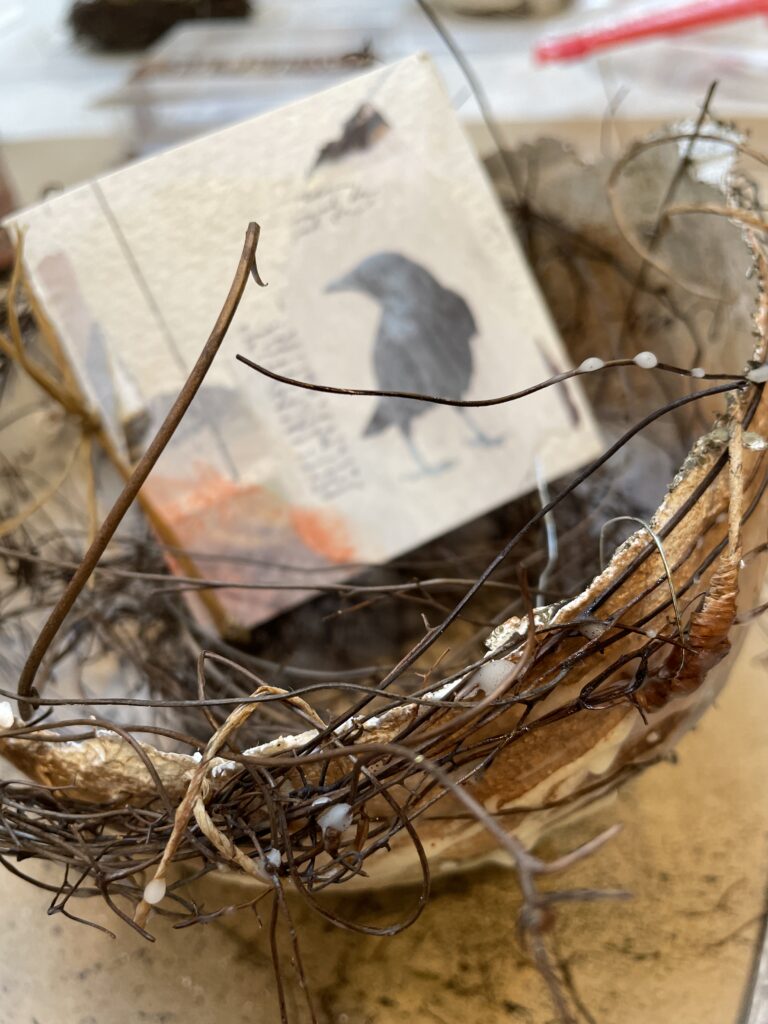
  • Mixes two or more of these media in one piece.
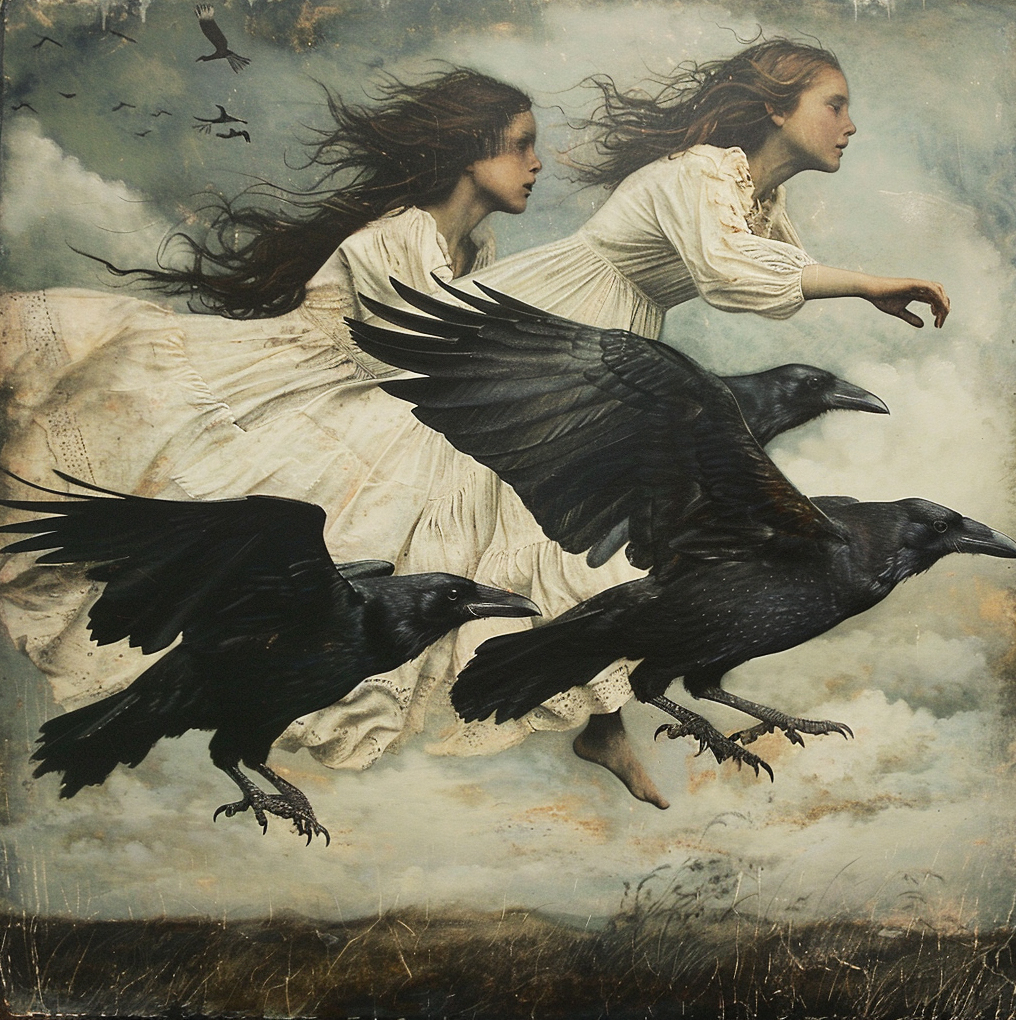
  • Returns to favorites but rarely stays still for long.
  • Values process and discovery as much as polished results.

This is such an appealing oracle card to me – it describes both the frustration and the satisfaction of being a mixed-media explorer. 


I’m almost at the end of creating the Enso Oracle, and this unexpected addition reminded me that creative work is rarely linear. Even when we think we’ve reached the finish line, something new can emerge that feels absolutely right. The Honeybee will join the other cards as part of the Path of Discovery, honoring those whose practices are built on curiosity and connection.

Sometimes, the last piece isn’t an afterthought — it’s the one that makes the whole feel complete. Stay tuned!

The Hump, The Clock, and Creative Risk

Jo Etta Jupe

Last Friday, three friends and I gathered for an informal studio session to test out a couple of techniques I am going to use this spring at a workshop I’m teaching at UTSA/SW. It’s called Vessel Alchemy: Tactile Poems in Fiber, Paper, Word, and Light

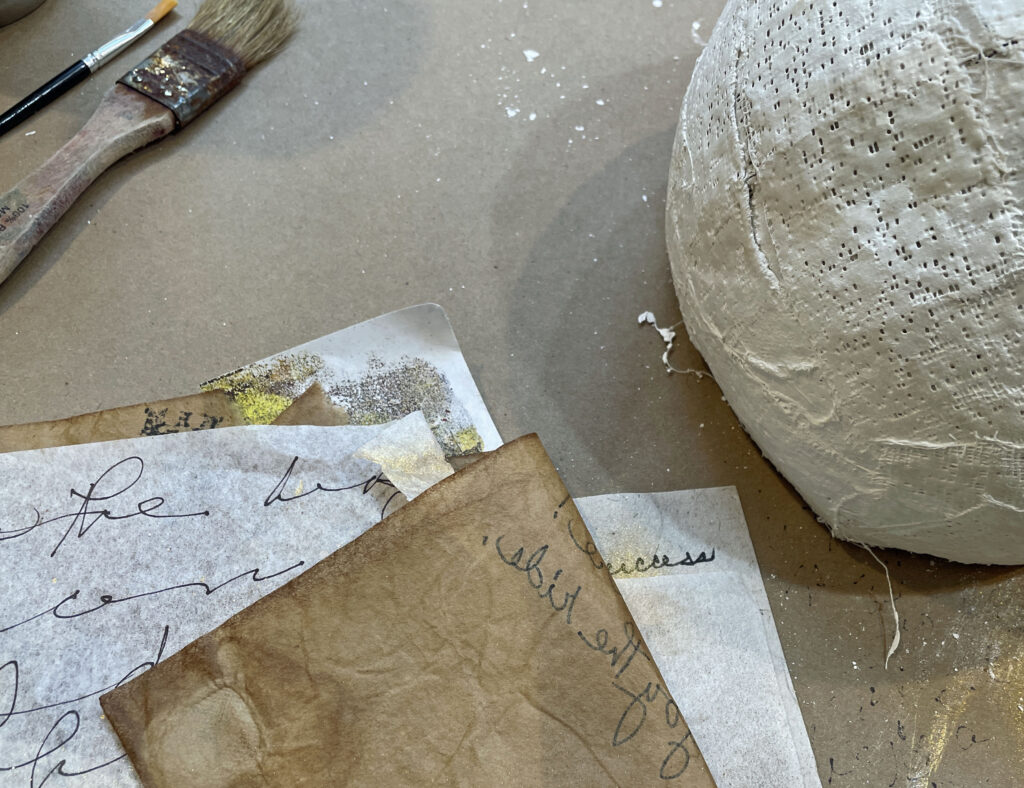
We had just four hours to experiment — I had “borrowed” the Semmes Studio at the Art League for our playtime .Normally, this vessel-making process unfolds over two leisurely days. So the plaster didn’t dry as fast as we expected, and while our asemic writing on tissue was ready, we still needed to try the beeswax on the vessel surface.

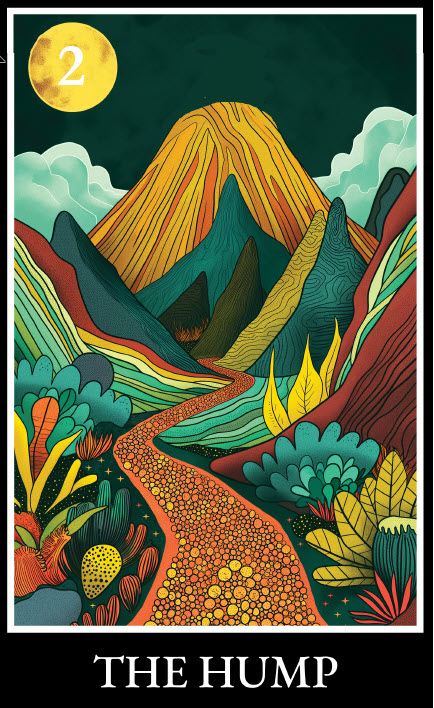
Remember the Oracle card called The Hump? That obstacle in the road? We were looking right at it, and the clock was ticking.

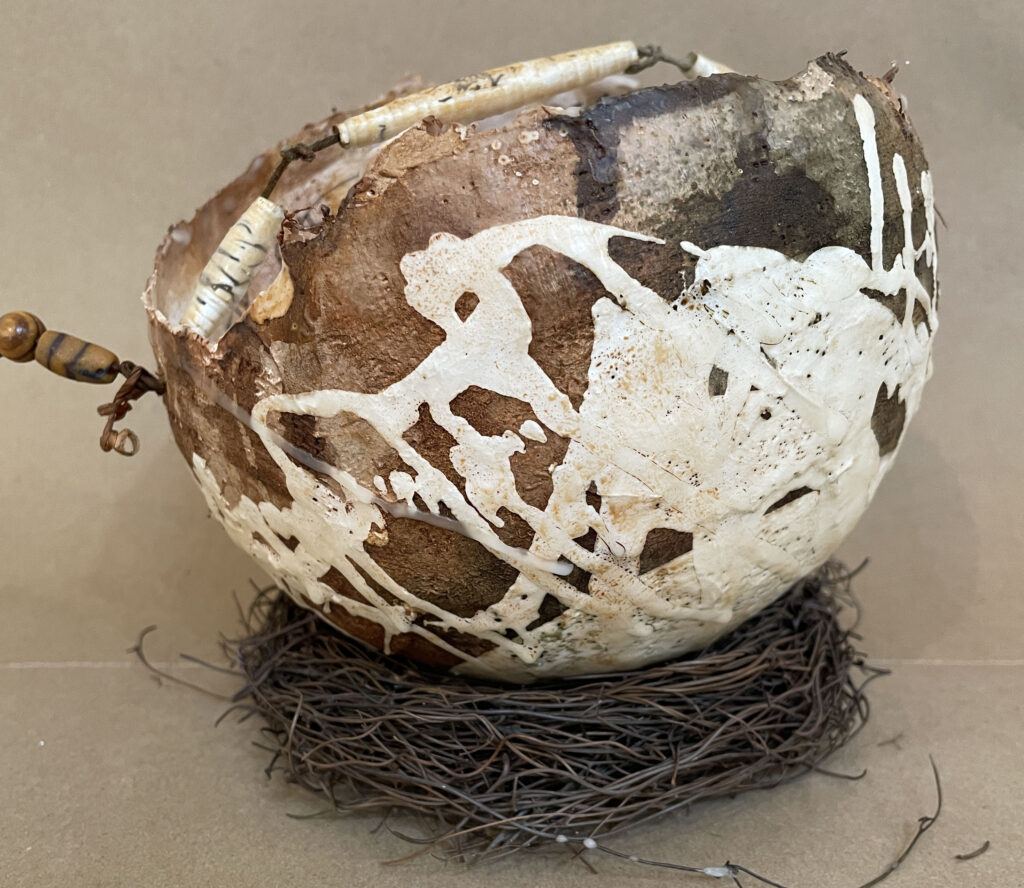
There was no time to second-guess. No time to over-plan. We just tweaked the process, took a few creative risks with the wax, and pushed right up against the edges of what felt possible. We used hot beeswax on cold plaster and fiber.

We had already put beeswax over damp “Irish paper” with good results (the hot wax dried the paper) . . .

. . . .so we rushed the process a bit. And here’s the surprising part: the results were beautiful.

Mary Zinda

I’ll admit, I worried we might have compromised good studio practices for speed. But the work told a different story. The pieces had clarity and energy — not the brittle look of something rushed, but the alive look of something made with intention and momentum. And the wax was stable.

Jean Dahlgren

That kind of creative compression can be exhilarating. It really is same energy that inspired the Enso Oracle card, The Hump  — the moment of tension before a breakthrough. When the usual pace isn’t an option, you find new ways to move forward.

You trust instinct over perfectionism. And often, that’s where the real results happen. This is one of the statements on the back of The Hump card:

“Sometimes the best work happens when you don’t give yourself time to talk yourself out of it.”

I’m reminded how much of artmaking is about risk — not the wild, reckless kind, but the kind that asks you to trust the materials, your hands, and the moment. This little four-hour experiment turned out to be a master class in exactly that.

But here’s the thing: there’s a big difference between taking a creative risk and just blowing past good sense because you’re in a hurry. If you don’t have time to do something safely or properly, that’s a sign to pause, not push. The Hump, bless its heart, will still be there tomorrow, patiently waiting. You can experiment, improvise, and trust the process without ignoring the basics that keep you and your work in one piece.

Creative bravery isn’t about being fearless — it’s about being smart enough to take the right kind of risks. And as I’m always telling you (and myself): trust the process. Or in this case, “tweak the process.”

Have you ever had a creative project come together better because of a time constraint or unexpected pressure? Some people swear they do their best work at the last minute. I’d love to hear your stories.

The Art of Magical Thinking

“If we see three black crows, we will gain the power to fly . .”

A long time ago, I did a practicum in an inpatient psychiatric hospital for children as part of my post-grad Special Ed certification. That’s where I first heard the clinical definition of Magical Thinking. Psychologists define it as the belief that thoughts or actions can influence events in ways that defy logic.

We usually think of magical thinking as something we’re meant to outgrow. As children, we believed our thoughts could make things happen — if we wished hard enough, if we didn’t step on cracks, if we crossed our fingers just right. I have to say that I still hang on to that, because in the studio, it can be an interesting source of insight.

A bit of “magical thinking” allows us to trust the invisible steps of the process: that one step will lead to another, that an image will unfold as it’s meant to, that meaning will appear when we stay open to it. We let imagination do the work that logic can’t always reach.

And honestly, I still do it outside the studio too. I’ll catch myself thinking, “If that stoplight doesn’t turn red before I get to it, that means I’ll get into the juried show.” Or “If the cat jumps on the table before I finish this email, it’s a sign I should change the title.”
It’s funny, but I suspect I’m not the only one.

This isn’t superstition. It’s pattern recognition — an intuitive attunement to the subtle cues that guide creative flow. Artists notice coincidences, accidents, and repetitions, and interpret them as meaningful rather than random. That interpretive act — seeing meaning where others see chance — is our version of magic.

When practiced consciously, this kind of thinking deepens our connection to both process and perception. It reminds us that artmaking is not only about control but about collaboration — with materials, with time, with uncertainty itself. We may not believe that the brush has a will of its own, but we do believe that if we listen closely enough, it will show us something we didn’t expect. Did you ever try mark-making with your non-dominant hand or with your eyes closed? Do you ever choose an Oracle card?

Even neuroscience nods to this kind of enchantment. Studies show that creativity lights up the brain’s default mode network — the same system that activates when we daydream, imagine, or find patterns in randomness. So when we follow an intuitive hunch in the studio, it’s not superstition. It’s the mind’s natural way of finding meaning in chaos.

In that sense, magical thinking isn’t about bending reality. It’s about perceiving more of it — noticing the signals, patterns, and echoes that point the way forward when reason alone runs out of language.

Magical, 2021

Maybe the real magic is that moment when everything suddenly feels connected — when a found object, a stray mark, or a line of color speaks back to you and says, yes, this belongs, when an answer magically appears. Remember the original Pendulum Post from Ireland? Real-life example!

For fun, checkout my Substack post – there’s an “artist-brained” guide to magical thinking – and thanks for reading!

Juried Shows and Oracle Cards

When I started developing the Enso Oracle Cards as a tool, I realized that they they can be a very practical resource. Beyond intuitive revelation, these cards offer metaphors that help us navigate the day-to-day challenges of studio practice. They remind us, in a humanistic and positive way, that perspective matters as much as process.

Just last week, I was accepted into the Fiber Artists annual Juried Show with my piece called Woolgatheringwonderful news, because this piece was unconventional enough that I wasn’t sure it would be understood.

Lyn Belisle. 2025

So I also know the outcome could just as easily have been a polite “not this time.” That is the nature of juried competition. When the stakes feel high, reading an oracle card can provide a way to step back, breathe, and reframe the experience.

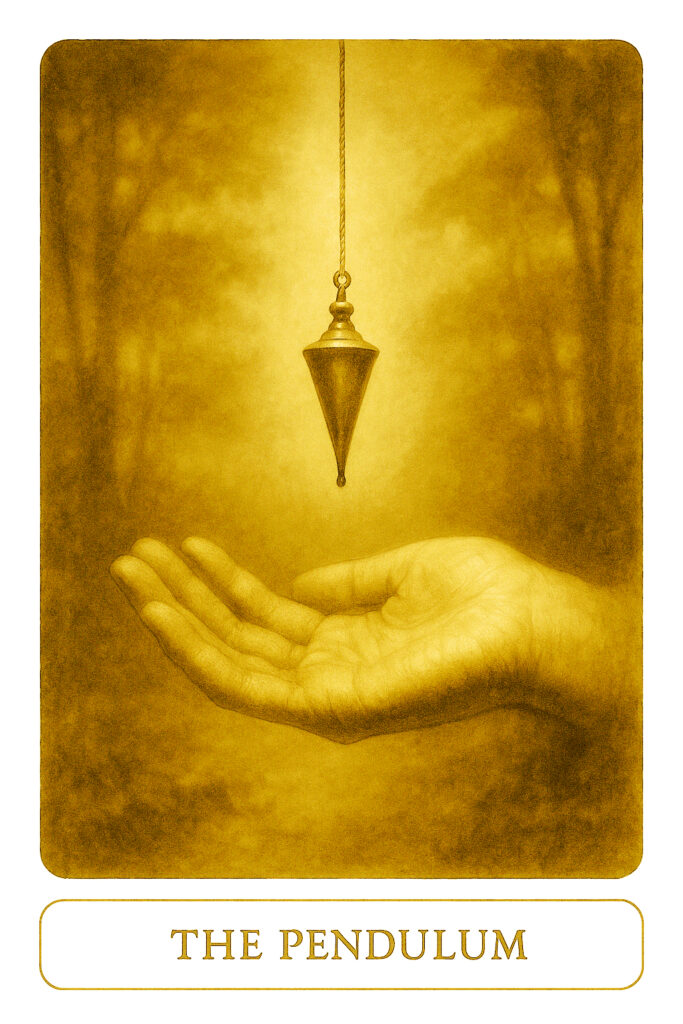
For example, The Pendulum card offers exactly this kind of perspective: a reminder that acceptance and rejection are simply two ends of the same swing, part of the rhythm of creative life.

When we draw this card—or choose it intentionally in a moment of reflection—it reminds us that the back-and-forth is not personal, it’s part of the rhythm of being an artist in the world. The swing of the pendulum is natural, inevitable, and temporary.

Juried shows are not a verdict on the value of your art. You know this.They are a reflection of one juror’s perspective, shaped by their own experiences, tastes, and the constraints of the exhibition. Just as a pendulum does not stop at either extreme, the outcome of any one competition does not define your entire creative practice.

In fact, The Pendulum asks us to look at where we stand in relation to those swings. Are we letting a rejection pull us too far into self-doubt? Are we letting an acceptance push us into overconfidence? The wisdom of the card is found in the center—the still point at the bottom of the swing—where we can observe both movements without being carried away by them.

As a practical exercise, if you’re entering a show or waiting on results, you might place The Pendulum card on your studio table. Sit quietly with it and ask:

  • What am I letting swing me off balance?

  • Where is the calm center I can return to, regardless of outcome?

  • What steady rhythm of making can I trust more than the verdict of a juror?

This practice shifts the experience of competition from one of judgment to one of balance. The card becomes less about predicting success or failure and more about anchoring yourself in the ongoing rhythm of your creative life.

What matters most is not the swing itself, but your ability to find stillness at the center and keep creating with steadiness and joy. It’s all perspective.

Now if only an actual pendulum could give me a positive yes or no answer about whether the piece will be accepted . . . .or maybe the waiting is part of the game 🙂


If you live in the San Antonio area and wold like to know more about the Fiber Artists of San Antonio Exhibit, here you go! Hope to see you there!

Cultivating “Enoughness”

Every once in a while, a word drops into my lap and refuses to let go. This week it was enoughness. I first used it when talking with our Enso Circle Continuing Residents about wabi-sabi and the endless challenge of cleaning and organizing a studio.

Here were those observations about the difference between “normal” intent and “wabi-sabi” mindset:

Conventional Studio Clean-Up
  • Striving for order: Every tool in its perfect drawer, every scrap of paper sorted or discarded.
  • All-or-nothing mindset: Belief that the studio must be fully “finished” before any new work can happen.
  • Stress and guilt: Overwhelm at the clutter, shame for letting it get “out of control.”
  • Time sink: Hours (or days) spent chasing an idealized, showroom-ready workspace.
Wabi-Sabi State of Mind
  • Enoughness: Accepting that some piles, stains, or chaos are part of a living, creative space.
  • Incremental rhythm: Tidying in small, mindful gestures that create breathing room without demanding perfection.
  • Compassion for self: Seeing clutter not as failure, but as evidence of energy, exploration, and process.
  • Organic order: Letting the studio evolve toward usefulness and comfort, rather than an imposed ideal of spotless control.

Enoughness. Funny word. But the more I sat with it, the more it started to echo through my own art practice.

Enoughness is not about settling. It’s not shrugging and saying, “Well, that’s good enough, I’ll just stop here.” Instead, it’s a sense of completion that comes when a work, a studio, or even a moment feels whole—alive—without needing to be flawless. It’s the place where beauty and imperfection meet.

As I’ve been creating the shard-based assemblages for our upcoming Taos exhibition, I’ve been struck by how the broken pieces seem to carry this truth. A shard of clay, a fragment of a vessel—these are not discarded failures. They are clues. They invite me to listen and to assemble them into a new wholeness that doesn’t erase the breakage but celebrates it.

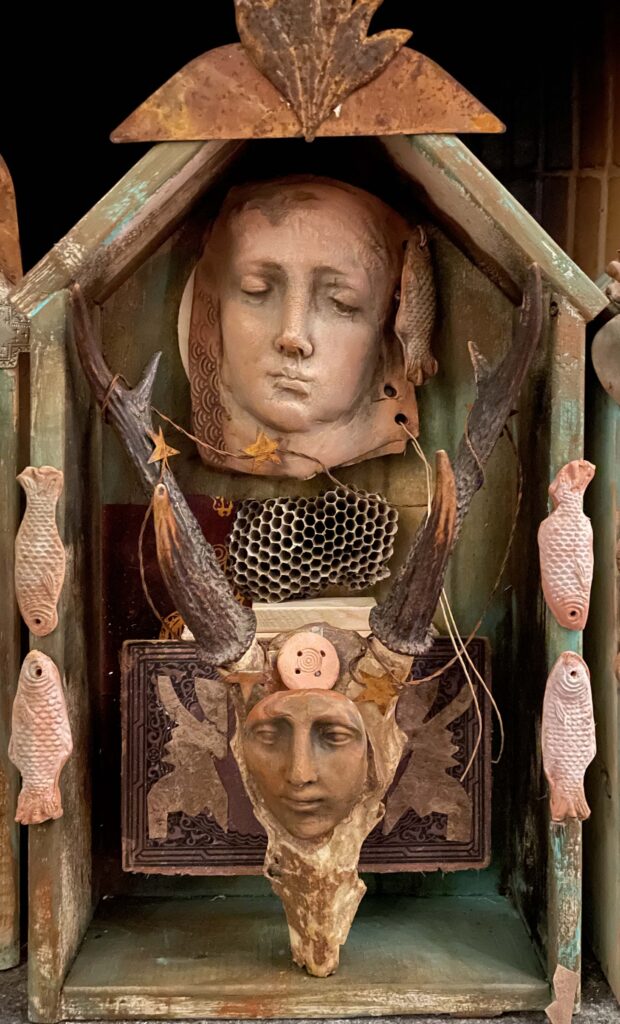
This assemblage is a conversation in fragments: a face, a hive, antlers, fish, stars. None of these pieces were “whole” when I found them, yet together they created a balance that felt complete. I remember pausing as I worked, holding another small object in my hand, and realizing that if I added more, the story would start to unravel. That moment was enoughness—when the piece declared itself “finished”, not because it was perfect, but because it had found its voice.

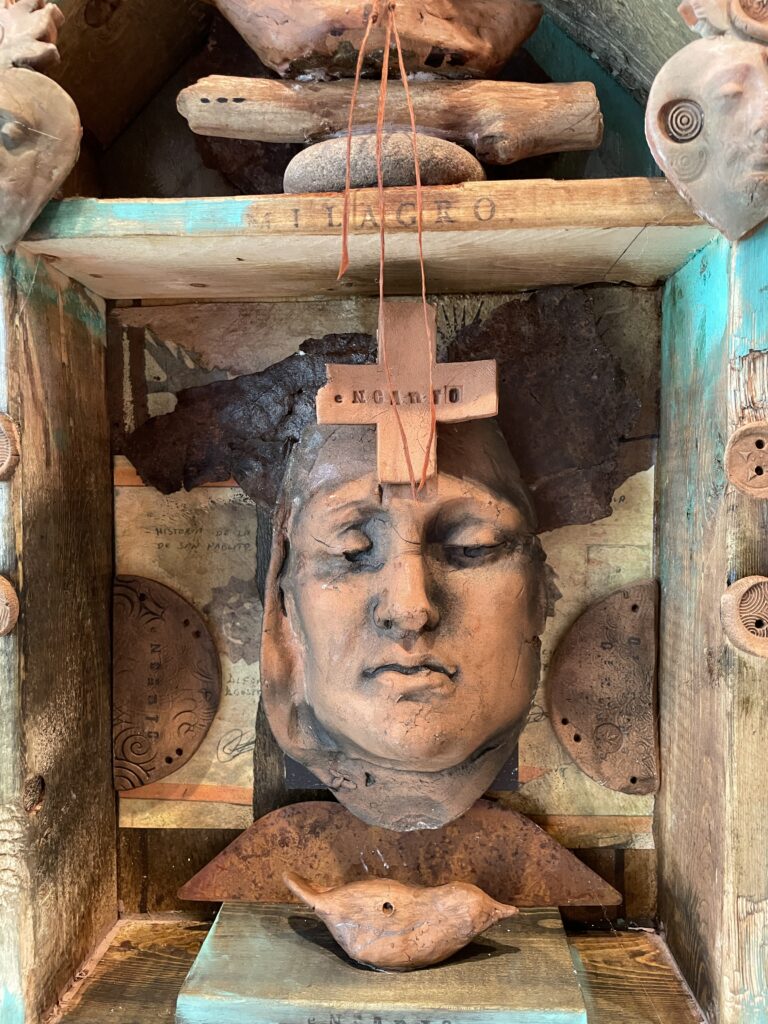
Here, the clay face rests beneath the word encanto and a small bird. The cracks and weight in the features carry their own gravity, so when I tried to “fix” the balance with additional adornments, the power of the piece diminished. The bird and the word were all that was needed. Enoughness is sometimes choosing silence over noise.

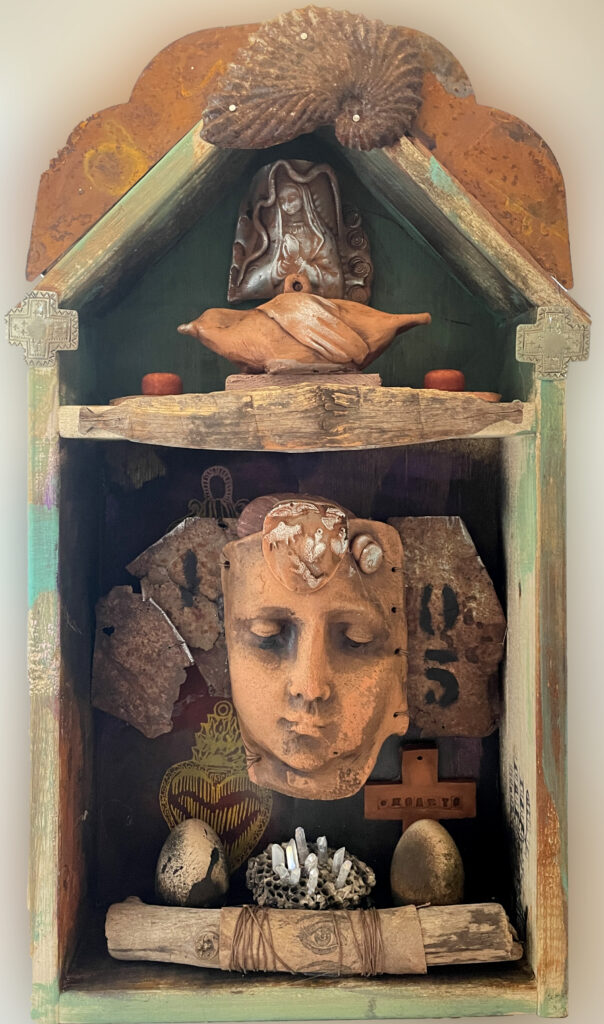
This assemblage reminds me how enoughness is about honoring the fragments for what they are. Rusted tin, clay shards, a hive filled with crystals—each is incomplete on its own. Together, they form a shrine that feels both fragile and eternal. Enoughness comes when the materials themselves breathe, and I don’t need to push them further.

When I’m working, there’s always the temptation to keep adding more: another layer, another fragment, another mark. But the piece itself tells me when it’s had enough. That moment of recognition—that quiet knowing—is enoughness. To go further would risk dulling the spark. To stop short would leave it unresolved. Enoughness is the balance point, the breath between too much and not enough.

This is where wabi-sabi sneaks in. The Japanese aesthetic of imperfection and impermanence reminds us that cracks and scars are not flaws to hide, but part of the story. Enoughness is wabi-sabi in motion, the living edge where a work becomes whole not despite its fragments, but because of them.

As I gather shards and build these new assemblages, I’m reminded that enoughness is not only about art—it’s about life. A studio doesn’t need to be pristine to be ready. A piece doesn’t need to be perfect to be powerful. And perhaps we don’t need to be flawless to be whole.

So here’s a reflection for you, SHARD readers:
How do you know when your work—your art, your home, your life—has reached enoughness? Not perfect. Not abandoned. But complete in its storytelling.